Wherever I went over the past month, Sage came too. She loves getting out and about. Today, we went through our photos and made a little slide show of our adventures. Enjoy.
It’s only 11 months till next Bookweek. Can’t wait 🙂
Wherever I went over the past month, Sage came too. She loves getting out and about. Today, we went through our photos and made a little slide show of our adventures. Enjoy.
It’s only 11 months till next Bookweek. Can’t wait 🙂
My apologies for the lack of regular posts this past month. Bookweek hit me! And, in author-land, Bookweek is rarely just one week – and, in fact, for me it’s been four weeks, visiting schools and libraries in regional Western Australia, metro Perth, as well as Townsville. I also presented at the ALEA/ACMI State Conference in Melbourne.
I’m back at my desk now, working hard on caching up, and there will lots of new posts in the next few weeks. It’s great to be back.
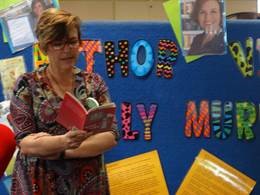
Reading fro Sage Cookson’s Sweet Escape at Adam Road Primary in Bunbury.
Yesterday I shared ten tips for successful author visits aimed at teachers and librarians (you can see that post here). Today, I want to share another ten, but this time aimed at presenters. Visiting schools and libraries can be lots of fun, and also form an important part of your income stream. I’ve done lots and lots of these visits, and the following tips are some of the things I’ve learnt along the way.
1. Advertise your availability. If you want to do school and library visits, you need to let schools and libraries know you are available. List on your website (you do have a website, don’t you?). You can als o create a flyer and distribute it by mail, or at conferences you attend. Word of mouth is also a wonderful tool.
2. Be upfront. It is easier to discuss payment and conditions at the time of the booking, than it is on the day you turn up, or after the event. State your rates, how many sessions you will do in a day, audience size, age groups you can cater for and so on. Talking about money can be uncomfortable, but it is necessary, which leads me to number 3:
3. Charge for your visit. With few exceptions, you should ask for ASA Rates for your time. An author/illustrator visit is an educational experience for children and helps teachers and librarians to motivate kids to read/write/draw. The rates may sound high when you’re starting out, but trust me you will earn them – it is a lot of hard work(fun, but also exhausting).
4. Be aware of the difference between promoting your book and promoting literacy. If your visit is in school time, it should be more than just a sales pitch. You are being paid for your time, so make sure you are giving value for students and for teachers. What are children going to learn from you – it might be something specific to your book, or about books and reading more generally.
5. Prepare your presentations. Work out what you have to say and how you are going to say it. A ‘meet the author’ session, for example, might include a reading of your book (or part of it), a talk about the research or creative process, and time for questions. If you’re an illustrator, you might show how you drew the main character. A writing workshop might teach a specific writing skill. Think about your own skills, the book, and the target age groups.
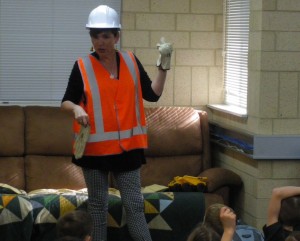 6. Have props or visuals. Kids like having things to look at. Some presenters use Powerpoint presentations, which can be wonderful when used well. A good one will be high on pictures and low on text. other props could be puppets, costumes, historical artifacts, you name it.
7. Know what you are going to say. This is kind of like 4 above, but this time I’m talking about knowing your presentation. Don’t read from a script or written speech, and certainly don’t read a Powerpoint. If you are nervous, practice. A lot. In front of a mirror, in front of friends, in front of your cat. Use your rehearsals to work out timing, remembering timing can be affected on the day by your nerves, by interruptions and by questions.
8. Be flexible. Be prepared for curve balls. What will you do if the Powerpoint doesn’t work? What will you do if you leave your book at home? What will you do if Johnny in the front row farts or – worse still – throws up? I was once booked to run a writing workshop for 20 kids. On the day 80 kids came into the room – and not one of them had anything to write with. Be prepared for misbehaviour. It won’t happen every time, but remember you are dealing with schoolchildren and, as such, kids will misbehave. They might call out, or talk when you are talking, or throw things at you. How are you going to respond? It is good to remember that the teachers should be there in the room and you can ask them for help in this area, but it is great if you can avoid interrupting the class to do this. I try not to expect perfect behaviour, and only stop my presentation if the behaviour is affecting other children’s ability to see or hear me.
9. Use prizes/rewards. Small giveaways such as bookmarks are very popular. Of course, if you are a softy like me, you might find it hard to give away only one or two, particularly for younger children. I tend to have a few things on hand in case someone comes up with a particularly brilliant question or answer, or if I need a volunteer top help out with something.
10. Follow up after the visit. Ask the person who booked you for a few words of written feedback via email. Take the time to thank them for having you. Also take the time for yourself to think about what did and didn’t work well – and why.
Have I missed anything? If you have any tips for school visits, I’d love to hear them. Leave a comment.
I’ve been on the road for over a week now. First I flew to Adelaide for a conference of English and literacy teachers, and now I’m in Wagga Wagga for a conference of children’s literature academics. Tomorrow, I fly home, and, while I love travel, I’m ready to head back to my family.
Anyway, last Sunday I attended a session presented by Alan Wright, a teacher and poet who seems to love poetry as much as I do. The session was packed with poetry and poetry ideas, but one form that he mentioned looked like a lot of fun, and the next day I found myself writing them in a cafe.
I’m talking about lunes, a poetic form which consists of just three lines – the first one including just three words, the second one five, and the third three. The last line should also try to be a surprise or a twist. You can see Alan’s explanation of the form here.
So, I had just been for a walk along the river in Adelaide, admiring the river, the bird life and the sights, so I had plenty of material to write about. What I didn’t instantly realise is that I had enough for a suite of three linked lune, ad with a bit of a nod back to last week’s Poetry Friday post.
So, here goes, complete with pictures (and a video).
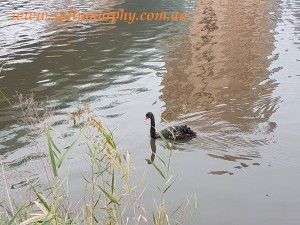
A morning walk
Admiring the beauty all around
Chased by goose.
Chased by goose
Wanting his own special souvenir
From this day
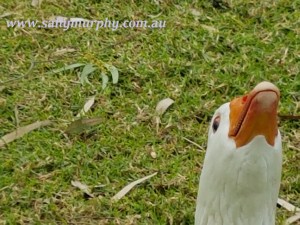
From this day
I will love only you
My beautiful selfie.

Today’s Poetry Friday roundup will be hosted by A Year of Reading. Head over there to see what other poetry goodness is happening across the blogosphere.
Last week I was lucky enough to be the author in residence at Mandurah Catholic College, which was celebrating its annual Bookweek. The staff and students made this a really happy visit – from the library display of my books, to the wonderful efforts at portraiture, and, of course, to the engaged, enthusiastic students from kindergarten through to year 9. Here’s a little video featuring the displays and some of the wonderful author portraits. Enjoy!
Thanks for having me, MCC.
As you may know from previous posts, I love getting out and about and talking about books and writing and reading and poetry to audiences of all ages.
So, I really enjoyed my two most recent festival visits – even though I’ve been so busy festivalling and catching up in between that I haven’t blogged about either of them. So, here goes.
Festival 1 was just down the road from where I live. Seven Rooms Seven Stories was a debut festival hosted at Mary MacKillop Catholic College in Busselton, and organised by the amazing Beth from Dymocks Busselton.
Beth and her team did an awesome job of organising the festival: everything ran so smoothly, it was hard to believe it was the first year this event was held. And I’m sure it won’t be the last. All the authors and illustrators invited were West Australian, which was a nice touch, and the audiences were keen, well prepared and very engaged.
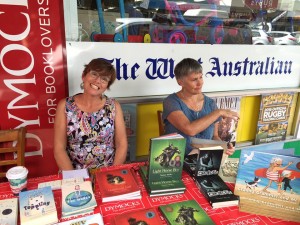
Signing books with the wonderful Dianne Wolfer.
Festival 2 was a little further away, in Albany, in the Great Southern Region – about 4 and a half hours drive away. I really enjoyed the drive down and back – it’s a beautiful road trip. The festival, the Southern Sea of Words, was hosted by Great Southern Grammar and organised by the lovely librarian, Karen.
The festival, over two days was lots of fun. Day 1 was spent with groups in the school and day 2 was open to the public, and I spoke to adults and children. I even did my debut session as a performance poet, which I loved and will blog on in an upcoming post.
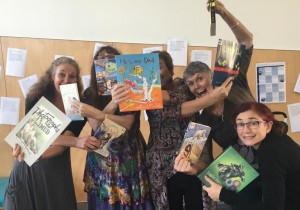
I promise I’m in this one! Having fun with Leanne White, Sandy Fussell, Dianne Wolfer and Deb Abela, some of the other presenters.
Now I’m back home and back at my desk . It’s always good to get back to work, but I do love getting out and about!