Jonathan Crossfield at the Copywrite blog has compiled a list of the top 50 Australian blogs on writing. There’s some goodies there – including several which are children or YA related. You can check it out here. There’s enough reading to keep you busy for quite some time.
Mabel’s Blog Tour
Today,I am delighted to welcome West Aussie children’s author and storyteller, Mabel Kaplan, to my blog.
Mabel is here as part of her blog tour to promote her picture book Connie and the Pigeons.
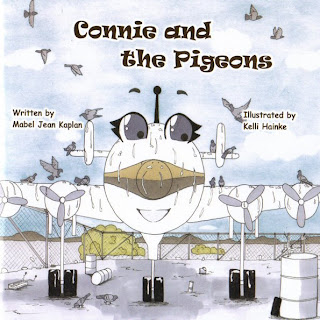
Thanks for dropping by, Mabel.
When I earned a place in the list of awards of a Writing for Children Competition run by a local Writing Centre for Connie and the Pigeons, I felt validated in my commitment to this story. I took careful note of the judge’s comments and did another edit or five (during which time I workshopped it at three primary schools) until I felt I’d taken it as far as I could. It was time to send it to a publisher I imagined would just be waiting for the Picture Book version of this story. It was 1996 and with the 50th anniversary of Connie’s first flight coming up in December 1, 1997, I thought I had a winner. Unfortunately, the publisher after keeping the manuscript for eleven months didn’t see the story in the same way. I knew I’d missed my 1997 deadline and let the book rest for a bit. I picked it up again early in 2004, did another edit, another school run before blitzing another fourteen publishers (in sequence) only to receive another fourteen rejections. By the middle of 2006, again the urge to have it published to coincide with an anniversary of Connie’s first flight – this time the 60th anniversary – took over. The only way to be sure that happened was to self publish.
2. How did you find an illustrator? Was it difficult to come to an agreement about rights for the illustrations?
For my school runs I painted a set of watercolour illustrations. Now I’m no artist but I do enjoy throwing paint around – and that’s what they looked like. Two friends offered to try their hand at illustrating. I used them for mu school visits and they were fun – but not suitable for the finished product. I took most of 2007 off from writing to edit two Children’s Anthologies for a local Writers Centre. During the process of editing the stories of various contributors, a warm relationship developed between me and one of the contributors. I discovered along the way that Kelli had a her passion for art and intended taking leave from teaching the following year to go to TAFE and undertake a course in Interior Design. I asked her if she’d like to try illustrating ‘Connie’. She was game for anything. So I booked us both into a couple of workshops for illustrators at the Fremantle Children’s Literature Centre – and we were away. There was no formal agreement about rights for the illustrations. We were naïve adventurers on a journey We just talked. I paid her per illustration and when the publisher had finished with the originals, I returned them to Kelli. Her TAFE lecturer was impressed with the work and insisted the illustrations form part of the portfolio of her year’s work. In addition, the following year Kelli also secured work during Children’s Book Week as a visiting illustrator in schools.
3. Can you describe the process from deciding to publish, to actually holding the finished book in your hand?
By this time, I decided to self publish I had learned quite a bit about the 32 page structure of a picture book and had played around creating storyboards and working out what text went where and how the illustrations fitted. I now set about playing with layouts and fonts. I decided on Kristen ITC 14 because it seemed a pleasant size, offering well-spaced lettering and a slightly quirky feel. I gave the text in its page by page format to Kelli the illustrator and she worked on drawing to fit. We adjusted text and layout as needed.
Once the book was ready, I put each text page into a separate pfd file and created another set of files of scanned illustrations in jpg. My intention had been, apart from the cover in full colour, to have the remainder of the illustrations in sepia. This, I thought, would help contain the costs. I sought quotes from four local printers. The variation was scary! I didn’t really understand what each was offering and was ignorant of the differences in digital compared to offset printing. In the end I settled for offset printing and full colour. The printer advised that sepia as a single tone would miss much of the detail and there would be little difference in cost between full sepia and full colour. I settled on a run of 750 books.
Dealing with the printer was the most stressful part of the process. I didn’t know what I should have asked for. One thing, in particular, that I should have asked for, was the proof in a full colour. Instead, I received it only in black and white. It was not until the books were delivered that I found shades that didn’t match; and, on two pages, colour omitted in parts that needed colour. Fortunately, I found a good quality coloured pencil of exactly the right shade. And now for the biggest laugh! As I open each box of books I spend an afternoon colouring by hand the two patches omitted. (Perhaps, I should be asking ask my readers to spot them! Instead, I’m hoping no-one will notice where they are.)
4. What do you see as the advantages and disadvantages of going it alone as a self-publisher?
To me the advantages lay in having the book available when I felt it needed to be; having control over design and layout the book; and, getting a book in print without depending on the vagrancies of the publishing world. The disadvantages include, particularly with respect to picture books, the cost and the process of dealing with the more technical aspects printing. I found marketing and distribution another huge challenge.
5. How have you distributed ‘Connie and the Pigeons’? Where can readers buy a copy?
Distribution has been largely through word of mouth. My initial launch of ‘Connie and the Pigeons’ was hugely successful due to it being held as part of the Friday assembly at the local school where I’d worked one day a week as the Storyteller in Residence for the past five years. I also targeted a couple of bookstores and aircraft museum outlets and donated a number to libraries and schools I’d worked in. I currently hold less than 300 books
Connie and the Pigeons is available through Westbooks in Victoria Park WA (08) 9361 4211
Email: orders@westbooks.com.au; online through http://www.justlocal.com.au/clients/book/mabel-kaplan/ or direct from the publisher Stories for the Telling 54 Hudson Avenue Girrawheen WA 6064 Tel. (08) 9342 7150 Email: mabelka@hotmail.com
6. What advice would you give to other authors trying to get their first book published?
If you have the passion, go for it. Find out as much as you can about the technical aspects of having your book printed. Be aware that picture books are expensive. Books less reliant on coloured illustrations would be a better proposition. Some people will tell you about the advantages of scale. But, unless you are very confident of your potential sales I’d suggest you keep your initial run under 1000 copies. The advantages of lower costs per book with larger runs won’t seem as appealing if your left with boxes of book in the corner of the garage.
7. What next for Mabel Kaplan?
I currently have three children’s picture books: ‘Turtle Hunter’, ‘Jeb! Out! Shoo!’ and ‘I Don’t Do Mornings’ doing the rounds of potential publishers; I am working on what I hope will be a chapter book for 11-13 year olds set on Rottnest Island; I’m re-editing some manuscripts in need of a lift after having lain too long in my little bottom drawer; and I’m doing everything I can to distract myself from writing a longer work that has been rolling around in my head for a very long time.
If you would like to follow Mabel’s tour, you can see her at the following sites:
First touchdown is http://sallymurphy.blogspot.com/ (you’re here)
From there she will be a guest of Sally Odgers at http://spinningpearls.blogspot.com/ (tomorrow, March 24)
before flying on to visit Dee White at http://www.deescribewriting.wordpress.com/ (on Wednesday).
Thursday, aRefuelling stop at http://belka37.blogspot.com
And comingin to land on Friday, 27 March, with Brenton Cullen at www.bjcullen.blogspot.com
And comingin to land on Friday, 27 March, with Brenton Cullen at www.bjcullen.blogspot.com
Connie and the Pigeons is available through Westbooks in Victoria Park WA (08) 9361 4211
Email: orders@westbooks.com.au; online through http://www.justlocal.com.au/clients/book/mabel-kaplan/ or direct from the publisher Stories for the Telling 54 Hudson Avenue Girrawheen WA 6064 Tel. (08) 9342 7150 Email: mabelka@hotmail.com
Email: orders@westbooks.com.au; online through http://www.justlocal.com.au/clients/book/mabel-kaplan/ or direct from the publisher Stories for the Telling 54 Hudson Avenue Girrawheen WA 6064 Tel. (08) 9342 7150 Email: mabelka@hotmail.com
For those on the Eastern coast it is also available from
HARS Souvenirs cnr Airport and Boomerang Roads
Albion Park Rails, New South Wales 2527
and
Qantas Founder Outback Museum PO Box 737 Longreach Qld 4730
Brenton is Back
Today, I welcome young writer Brenton Cullen to my blog. Brenton is here as part of his blog tour to promote his mystery book Ronda’s Gang and the Stolen Wallet. This is Brenton’s third visit to my blog, having previously taken up the challange to answer my seven questions, and also calling by on his tour to promote his other book, The Writers.
Welcome back Brenton. Because you’ve been busy on tour, answering lots of questions, I decided to mix things up a little and also set you a challenge. So, here it is. Insetad of the usual five or six questions, I’m going to ask you twenty questions. And, because I’m mean, I want you to answer each question in just one word. Think you’re up to it? Well, here goes.
1. Describe yourself.
Intelligent
2. Describe Ronda’s Gang and the Stolen Wallet.
Appealing
3. What kind of reader will enjoy Ronda’s Gang and the Stolen Wallet?
Kids
4. Describe Ronda.
Outgoing
5. Describe James.
Whiny
6. Describe Mrs Kratzman.
Cunning
7. Who is your favourite character in the book?
Ronda
8. Why?
Because.
9. What is the best part about being an author?
Mail
10. What is the worst part about being an author?
Rejection
11. Describe your workspace.
Messy
12. What are you reading right now? (you can use more than one word if the title is longer)
Harry, A History: The True Story of A Boy Wizard, His Fans, and Life Inside the Harry Potter Phenomenon by Melissa Anelli
13. Are you enjoying it?
Yes.
14. Who is your favourite author?
JK Rowling
15. Why?
Creative.
16. What will you write next?
Fantasy
17. What is your ambition/dream?
MeetJKRowling!!
18. What did you do just before you started this interview?
Emailed
19. What will you do as soon as you finish it?
Write.
20. Why should people read your book?
Appealing
Intelligent
2. Describe Ronda’s Gang and the Stolen Wallet.
Appealing
3. What kind of reader will enjoy Ronda’s Gang and the Stolen Wallet?
Kids
4. Describe Ronda.
Outgoing
5. Describe James.
Whiny
6. Describe Mrs Kratzman.
Cunning
7. Who is your favourite character in the book?
Ronda
8. Why?
Because.
9. What is the best part about being an author?
10. What is the worst part about being an author?
Rejection
11. Describe your workspace.
Messy
12. What are you reading right now? (you can use more than one word if the title is longer)
Harry, A History: The True Story of A Boy Wizard, His Fans, and Life Inside the Harry Potter Phenomenon by Melissa Anelli
13. Are you enjoying it?
Yes.
14. Who is your favourite author?
JK Rowling
15. Why?
Creative.
16. What will you write next?
Fantasy
17. What is your ambition/dream?
MeetJKRowling!!
18. What did you do just before you started this interview?
Emailed
19. What will you do as soon as you finish it?
Write.
20. Why should people read your book?
Appealing
You’re a good sport, Brenton.
You can buy Ronda’s Gang online from Lulu, and can follow Brenton’s blog tour at
tips4youngwriters (18 March)
http://spinningpearls.blogspot.com/ (19 march)
sallymurphy.blogspot.com (you’re here) and
Tales I Tell (21 March)
Self Doubt
I have twenty seven books in print – and more in production – I run a popular book review site and some blogs , I have run writing workshops, and spoken at festivals and numerous school visits. And yet I still wonder if I’m a ‘real writer’. When people ask me what I do, I don’t always tell them I’m an author. More often I tell them I’m a mum (which is still my most important and difficult job) or a teacher. At festivals and conferences I’m sometimes tongue tied or just plain blithering when I talk to other published authors. And I still hesitate to submit manuscripts to publishers, worrying that they’ll think I’m an idiot for sending them such rubbish and being surprised when I get an acceptance.
I confess this self doubt is sometimes a problem. I know it makes me appear aloof at times, because if I’m feeling unconfident then I’ll sometimes simply stay out of things rather than participating. At other times I am too loud, overcompensating for my fears – I definitely don’t appear to be a shy person. When I had a long period between acceptances, my self doubt became almost crippling, and I seriously considered giving up writing
I’ve always worried about this lack of self-belief. If I express it out loud, it makes me sound a bit self-deprecating, or even as if I’m fishing for compliments – waiting for someone to tell me how wonderful I am – or, at least, my writing is. But, after another spell of this self doubt, I’ve come to realise that it’s not such a bad thing.
Because I have self doubt, I do hesitate before hitting send on that submission. And that hesitation makes me reread and see what is missing.
Because I have self doubt, I don’t tend to take rejections personally – meaning that instead of wallowing in a sea of ‘they don’t know what they’re talking abouts’ I instead try to consider how that manuscript can be improved before sending it back out.
Because I have self doubt, I know I need to keep studying my craft – through attending workshops, reading articles, blogs, how-to books , studying ‘good’ books to see what works, listening to the wisdom of ‘real’ authors at conferences and so on.
And mostly, because I have self doubt, I am absolutely thrilled when someone likes one of my books – and especially when that someone is a publisher who wants to publish one of my manuscripts.
Why am I telling you all this? Because the more I talk to, and listen, to other authors, the more I realise that there are many, many published authors who have similar self doubts. And I’m wondering if self doubt is not the problem I’ve always thought it to be – perhaps it is this very doubt which makes us able to sharpen our craft, celebrate the writing life and to strive to be better writers. Perhaps if I stop feeling doubt then my hunger to improve will diminish.
I would love to hear what other writers think about this. If you experience self doubt, do you think it helps you as a writer? And, how do you overcome that doubt so that you can keep writing and submitting? Leave me a comment.
Hot Link: Wonderful Blog Post About Rejection
Katherine Battersby, at the Well Read Rabbit blog (isn’t that a wonderful name for a blog, btw) has a wonderful post about rejection, which you’ll find here. Rejection is one of the hardest parts of being a professional writer. Katheirne’s article provides a wonderful take on the process of responding to a rejection. Enjoy!
Big Question 4: Favourite Dr Seuss Tale
He’s having a birthday, he’s having it now
So step up, Dr Seuss and take a big bow.
Okay, so my rhyme is NOT as Seussical as can be, but you get the drift – today, March 2, is Dr Seuss’s birthday. If he was alive today, Dr Seuss, or Theodor Suess Geisel would be 105. If you want to learn more about him, you can click here to visit the Seussville website.
To celebrate the day, I am asking another of my big questions. Today’s question is: What was/is your favourite Dr Seuss book, and why? Post your answer below in the comment section.
My own favourite as a child and still, is Horton Hatches an Egg, I think mainly for the sheer absurdity of the idea, but also for the wonderfully wrought rhyme and rhythm, and of course, the message of being true to your promises – and being justly rewarded!
What about you? What is YOUR favourite Dr Seuss book?
- « Previous Page
- 1
- …
- 33
- 34
- 35
- 36
- 37
- …
- 63
- Next Page »