Another month is over, and September saw me rejoin the library (which I hadn’t done since my move a year ago) and thus took me into some excellent recent kids’ books to supplement my never ending to-read pile. I read 16 books this month, including the library haul. Here’s what I got through.
Children’s Books
Speed of Light, by Joy Cowley (Gecko Press, 2014). This one had been in my to read pile for ages. Jeff loves numbers, and finds comfort in their patterns and predictability. With his family facing challenging times, that comfort is more important than ever.
Salih, by Inda Ahmad Zahri and Anne Ryan (Ford Street, 2021). The gentle cover art of this one jumped out at me on a library visit. A story of how art, hope and community help refugee Salih as he and his family search for safety. Beautiful.
The Big Backyard Plan, by Kirsten Ealand and Laura Stitzel (Affirm Press, 2025). Another library find, with the story of four young neighbours who play and grow together, and hatch a plan to convince their families to take down their fences so they can be even closer.
-
Paper-flower Girl, by Magrete Lamond and Mateja Jager (Dirt Lane Press, 2023). Yes, also from my library visit – these three made for a lovely lunchtime reading session. A story of creativity and what happens when a creative girl is forced to produce for a selfish Giant.
Staying Alive in Year 5 (Pan Macmillan, 1989). Not sure how this one made it’s way into my to-read pile, but enjoyed the quick read.
Sagittarius Rising by Maxine Beneba Clarke (Hardie Grant, 2026). A chaotic puppy book would always be a delight – but when it is written in verse, it’s extra delightful. I didn’t realise this was a verse novel when I borrowed it, so that was a lovely surprise.
Eighty-Nine Questions for After, by Ashleigh Barton (Lothian, 2026). Another library book. A mix of humour and mystery along with some really tender moments.
A Light on the Rocks, by Helen Edwards (Riveted Press, 2026). Historical fiction set in two time periods – 1859, when the SS Admella is wrecked, and in 1959, when Maxwell and his sister learn about the wreck, and experience mysterious events.
The Two-Thousand-Pound Goldfish , by Betsy Byars (Puffin, 1982). n oldie that’s been sitting in my to read pile for quite some time. I liked the mix of Warren’s daydreaming where he creates stories based on horror movie scripts, and the real world, where he struggles with some really difficult challenges.
The Wave, by Sarah Armstrong (Hardie Grant, 2026). A new release picked up when I was in Melbourne and needed a book for the plane. Lots of action – Max is caught up in a tsunami – along with topics including grief, trust and courage.
Twist of Gold, by Michael Morpurgo (Viking, 1993). Excellent historical fiction – Morpurgo is a leader in the genre.
Queen Narelle, by Sally Murphy, illustrated by Simon ‘-Carrigan (Walker Books, 2023). Yes, I read my own book. This is something I do periodically to see what I did well, and maybe what I can learn from past me, to improve present and future writing. Also, I read it because I had a granddaughter ask me to read it to her, which was a delight.
Silver Linings, by Katrina Nannestad (Harper Collins, 2023). The last of my library stack for the month, and, as with everything Nannestad writes, just a wonderful read.
Books for Young Adults
1.Work-Life Balance: Malevolent Managers and Folkloric Freelancers, by Benjamin Chee & Wayne Ree (Difference Engine, 2022). A graphic novel bought after the graphic novel panel at the AFCC earlier this year. I bought three of the panellists’ books and this is the third one, a slightly different format because it alternates prose chapters with graphic novel ones, which I enjoyed.
2. Brocky’s Bananagram, by David Metzenthen (Scholastic, 1994). Another one rescued from my to read pile. Think I picked it up in a op shop some time ago.
Books for Adults
Nine Perfect Strangers, by Liane Moriarty (Pan Macmillan, 2021). Collected from a local Little Free Library, in exchange for several children’s books. Perfect read for a long plane trip.
This brings my total for the year to an even 100, with more to come. I have a whole library to get through 🙂
 consider the
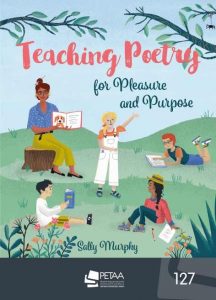 of its cousin, the Poetry Ponderance (which debuted in my book for educators,
  ponderance and, later, to the whole class.