Poetry Friday: Cruel Mother
A couple of weeks ago we had family visiting from Victoria, so we took them out for a lovely dinner on the waterfront in town. It was a perfect summer evening and a lovely evening. But the light show we glimpsed in the distance proved to be far more sinister than we imagined. Here’s my poem in response to that:
Cruel Mother
After dinner
we revel in gentle breeze
across darkening water
enjoy impromptu
lightning light-show
and marvel
at Mother Nature’s beauty.
Next day
and next
and next
and next
we watch
the firestorm
lit by that same lightning
destroy
forest
buildings
towns
lives
and wonder
how a mother
can be so cruel.
(Poem copyright S. Murphy 2016)
And, to show the foerocity of what came from that lightning storm, here’s a little footage:
Today’s Poetry Friday roundup is hosted by A Teaching Life. Head over there to see what other poetry offerings are on this week’s menu.
Pay Up: Why Authors Should be Paid to Speak (Part 2)
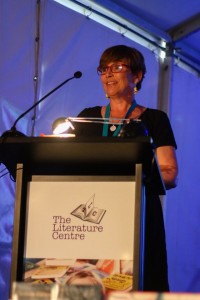
Speaking at Celebrate Reading at the wonderful Lit Centre, which always pays ASA Rates.
Yesterday I spoke about the reasons authors should be paid to speak. I spoke about why it was important for the authors to be paid, but I didn’t talk about what was in it for the people paying the authors – the festivals , schools and libraries who I’m saying should be paying authors for their time. So, here we go with why it makes sense to pay authors to speak:
- We entertain (and inform) audiences. The very popularity of literary festivals vouches for the fact that people want to meet and see and hear authors speak about their work, about life, about all kinds of things.
- When we are paid, we are more likely to go the extra mile. It makes sense, doesn’t it? If authors are being paid for their time, then they are likely to see presenting as a job, and therefor prepare well, and give generously of that time.
- Literary festivals, school author visits, library talks, dinner speeches etc etc all promote literacy and reading. In the case of children’s authors, this link is hopefully obvious – hearing from a real live author encourages children to read not just that author’s books, but more (and hopefully more and more). But this works for adults too. Hearing a good speaker read from and talk about a book leads people to read more.
- The hour long presentation is the culmination of many hours’ work. Although most festival and school sessions are an hour or less (with the exception of workshops), the fee paid to the speaker takes into account the amount of time that goes into preparing for the session as well as the years spent honing the skills used to write the book and develop speaking skills.
- Authors promote the festivals/events they speak at. Most authors use social media (Facebook, Twitter, blogs, websites) to spread the word about their appearances, drawing audience members, and spreading the word for future festivals. They also talk among themselves. A good festival experience will be shared with fellow authors socially. I have a wish list of festivals I’d love to attend based on their treatment of author friends. Payment is one part of this experience.
If you are running an event in Australia arnd are not sure what you should be paying, the Australian Society of Authors (ASA) has a detailed list of rates, which should be a great starting point. And, if you are an author, I encourage you to charge properly for your time. Again, thanks Philip Pullman for bringing this issue to the fore.
Pay Up: Why Authors Need to be Paid to Speak (Part 1)
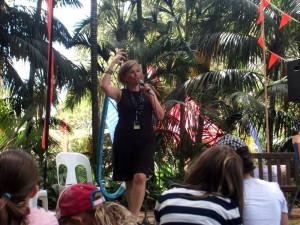
Speaking at the Perth Writers Festival, which pays ASA Rates. Hooray!
This week author Philip Pullman has been in the news for pulling his support of the Oxford Literary festival because it does not pay authors to appear there. Bravo Mr Pullman! The news that other prominent UK based authors have signed an open letter calling on authors to boycott literary festivals which do not pay has kept the topic in the spotlight. I thought I might devote some blog time to examining this issue from the Australian perspective .
Though in my experience most festivals here in Australia pay, and pay the recommended ASA Rates, I don’t know any author who has not, on numerous occasions, been asked to speak at a school, festival, library or other event for free. It’s happened to me more times than I can count.
There are two main arguments put forward for speaking for free. Firstly: standing up in front of an audience is great for promotion. People will hear you speaking and go and buy your book.
Let’s look at that for a moment. An audience might range from a few people to a few hundred people. Let’s assume I speak to a group of 100 people. And let’s say I am absolutely riveting in my presentation, which inspires all hundred of those people to buy one of my books. Should they each buy a $20 book, sales will come to $2000. A tidy sum for my hour’s work? Maybe, except of that $2000 my royalty cut, at 10%, is $200. That’s if the book is not illustrated (which most of mine are) , in which case my royalties are 5%, so $100. Which I’ll receive up to six months later, because royalties are paid twice yearly. Of course, a bigger audience might mean more sales, but the reality is that it is highly unlikely that every audience member will buy a book, especially at a festival, where there are numerous authors presenting, because attendees will need to make purchasing decisions based on budgets and the strength of their book-carrying backs.
Of course, promotion isn’t all about book sales on the day. Making a name for myself might lead to sales of future books, as well as future sales of my backlist (once they read one book, they’ll want to hunt them all out, right?) In my wildest dreams all 100 of those people might go and buy all 10 of the trade books I have in print – resulting in $20000 sales, and $1000 royalties. Over weeks, months or even years.
The second argument for speaking for free is about budgets. If festivals (or schools, or libraries, or whatever) paid authors to speak, then they couldn’t afford to hold the event. And of course we all want to encourage reading through such events, don’t we? Yes, we do. But this argument doesn’t hold up unless everyone else who works at the festival is also working for free. The program manager. The venue staff. The sound/lighting people. The printer of the programs. The catering staff. If these people – who all do important jobs – are getting paid, why not pay the talent? The people standing up front who are, after all, the ones that the audience is coming for, are entitled to be compensated for their time. Because if there are no speakers, there is no festival.
I said there were two main arguments given for not paying authors but there is a third, unspoken one: the implication that authors don’t need the money. Because we’re all rich. Right – if earning $12, 900 a year makes us rich. That’s right – the average Australian author’s income is less than $13 thousand a year. So that fee for speaking is much-valued income which gives us a little bit more time to write. When we speak for free we not only miss out on that payment, but we are also taken away from either writing, or from a day job which enables us to eat – because authors, just like every all humans , like to eat, and pay bills and so on.
So, thank you again Mr Pullman for standing up for authors. Thanks too to the many festivals and schools and libraries across Australia who pay authors properly. And thank you to the ASA who fight for the rights and conditions which Australian authors enjoy.
This post has focussed on why the authors need to be paid. Tomorrow, I’ll look at what’s in it for the festivals. .
Monday Book Quote
Poetry Friday: The Heirloom
Welcome to Poetry Friday. This is my first Poetry Friday post for 2016, and I want to share a poem I wrote in response to an unexpected Christmas gift.
The Heirloom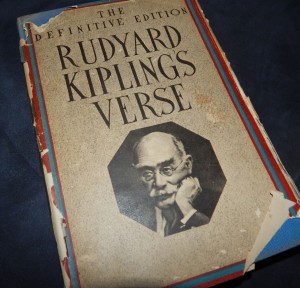
I can tell at once the gift is a book
and I wonder
what it is
my parents
(who gave me my love of words)
have thought to gift me now
that my house and life
are filled with books
I often pass on to them.
I unwrap the parcel
hoping I can show delight
to eager watchers.
I needn’t have worried.
An ageing book of poetry
was never likely to disappoint.
A perfect gift made more so
by my grandmother’s name
etched inside the cover
connecting the three generations
of first owner
gifters
and recipient.
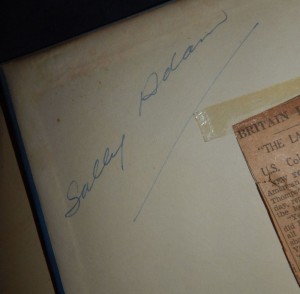
My Grandmother’s name, which we once shared.
Have a great Friday. This week’s roundup is at Keri Recommends.
- « Previous Page
- 1
- …
- 87
- 88
- 89
- 90
- 91
- …
- 210
- Next Page »