It’s World Read Aloud Day and, what better way for me to celebrate than by reading aloud to you. Enjoy!
View this post on Instagram
by Sally
It’s World Read Aloud Day and, what better way for me to celebrate than by reading aloud to you. Enjoy!
by Sally
So far in this series of posts, I’ve offered suggestions for books for Early Childhood and Junior Primary classrooms. Today, if you are a teacher of Middle Primary – years 3 and 4 – this post is for you. The goal is to highlight books I’ve written which you can use in your classroom, linking up with resources which can support you. I hope you find it useful.
Firstly, if you are looking for fiction to help you explore history, notable Australians or to link to the subject of HASS, then I have the following titles suitable for this age group.
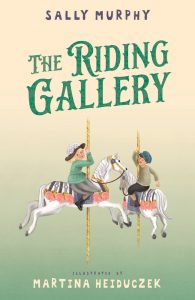
The Riding Gallery (illustrated by Martina Heiduczek, published by Walker Books). My most recent book, this is the story of the homefront during WW1, focussing on the events surrounding a real merry go round (riding gallery) on the St Kilda foreshore. Told using free verse from the viewpoints of two children, the merry go round operator, and the newspapers of the times. <P>What it Can Be Used For: As mentioned, there are HASS and history tie-ins, but, being a verse novel, this one can also be used to teach poetic forms (including found poems), figurative language and more. If you are in the ACT, you might link the story to the merry go round located in the Civic centre – as this is the very ride which features in the book – and, if in Victoria, the book again has strong links to local history, taking place in St Kilda.<P>You can find teacher notes at the Walker site here and PETAA has an excellent unit of work aimed at the year 3 classroom and linking not just to HASS but also to HPE. You can find that here . You can see and hear the organ from The Riding Gallery , as well as glimpses of the ride, still operating in Canberra, in this video.<P>The book is available in good bookstores in both print and ebook formats, as well as in libraries and could be used alongside the next book, also set in WW2 and also with links to Victoria.
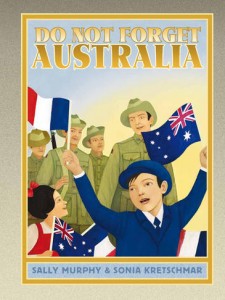
Do Not Forget Australia (illustrated by Sonia Kretschmar and published by Walker Books). Telling a story of friendship between two boys and between two countries, through the events at the French village of Villers-Bretonneux in and after World War 1.
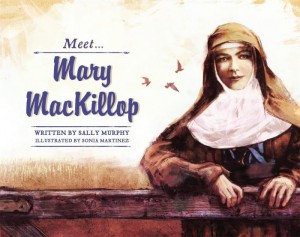
Meet Mary Mackillop (illustrated by Sonia Martinez, published by Random House). Part of the fabulous ‘Meet…’ series from random House, this is a fictionalised story of the life of Mary Mackillop, with a back of book timeline of her life.What it Can Be Used For: Because it features a famous Australian, there are obvious HASS uses, as well as use in Catholic schools, with Mary Mackillop being Australia’s first saint. But this is also the story of a strong woman, and highlights social justice and history, so is suitable for all classrooms. You will find publisher teacher notes here and suggestions for the year 4 classroom here. Meet Mary MacKillop appears on the booklist for the Victorian Premier’s Reading Challenge and is still available in good bookstores or online.Secondly, as well as The Riding Gallery, I have four other verse novels suitable for middle primary.
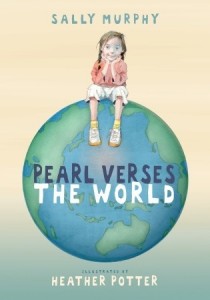
Pearl Verses the World (illustrated by heather Potter, published by Walker Books) is a story of belonging, of family and also of grief. Told using the verse novel format it again has links to HPE as well as making an excellent class read aloud.What it Can Be Used For. Because it uses free verse poetry (as well as some shorter rhyming poems), there is lots of opportunity to address poetic and language devices, including covering ACELT1600 (Discuss the nature and effects of some language devices used to enhance meaning and shape the reader’s reaction, including rhythm and onomatopoeia in poetry and prose.)and ACELT1604 (Use metalanguage to describe the effects of ideas, text structures and language features of literary texts), among many other uses.Teacher’s notes for Pearl Verses the World are available on the Walker Books website, and my ideas for using the book in a year five classroom are available here The book appears on the Premier’s Reading Challenge booklists in WA, Victoria and South Australia.
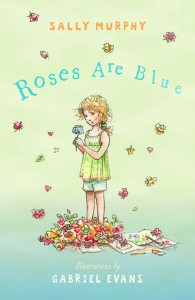
Roses are Blue (Illustrated by Gabriel Evans and published by Walker Books). As with Pearl, this can be used to adress HPE, poetry and other English outcomes, as well as making an excellent class read aloud. You’ll find Teacher’s Notes here and suggestions for using the book in a year four classroom can be found here. Although Roses are Blue is currently out of print, it can still be found in many libraries. and it appears on the NSW Premier’s Booklist.
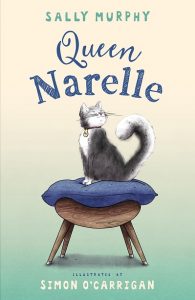
Queen Narelle (illustrated by Simon O-Carrigan and published by Walker Books) is a verse novel told from the alternating viewpoints of Maddie and her cat, Narelle. The use of the cat’s voice makes it fun, but the issue Maddie is facing – about friendship challenges – is very real, and very important. The exploration of friendship and bullying, as well as of family, makes it also an excellent text for HPE classes. You’ll find a simple teaching suggestion, pairing Queen Narelle with a stand alone poem, here.Queen Narelle is available in good bookstores or online, as well as in many school and local libraries and Narelle also features on the SA Premier’s Reading Challenge Booklist.
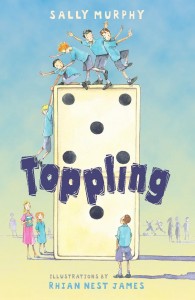
Toppling (illustrated by Rian Nest James, published by Walker Books). Although I would normally recommend this book in upper primary, I am including it ehre because it is included in the NSW, Victorian and SA Premier’s Booklists at this level. A story of friendship, it also delas with childhood cancer, giving it applicablity in the HPE classroom as well as a class read aloud. Teacher’s notes for Toppling are available on the Walker Books website and further suggestions are here. Although these are aimed at a year 6 classroom, they can be adapted for younger students.
And, while verse novels are a wonderful resource for teaching poetry, I also have three poetry-specific books suitable for middle primary.
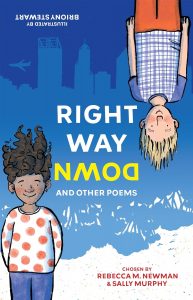
Right Way Down (edited by Rebecca M. Newman and myself and published by Fremantle Press) is aimed chiefly at middle and upper primary students and is suitable both for in class use and private reading, with poems in a wide range of of forms, and on a variety of topics, all written by contemporary poets. You will find teaching notes here and printable poetry activities here. Right Way Down is still available in good stores or online in hard copy or ebook format.
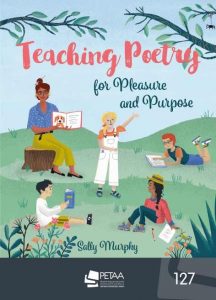
Teaching Poetry for Pleasure and Purpose ( Published by PETAA) is, as the title suggests, designed to help you in teaching poetry in pleasurable ways, but also with the purpose of supporting the demands of the curriculum. There is a chapter for each primary school year, including Years 3 and 4, unpacking key terminology, suggesting activities both in reading and writing, and including poems and suggestions for further resources. Teaching Poetry for Pleasure and Purpose is available directly from PETAA in both hardcopy and digital formats. PETAA also offer an online professional learning module of the same name, where you can hear more from me on the teaching of poetry.
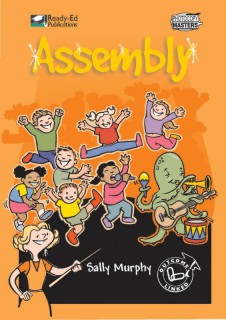
Assembly (published by Ready Ed Publications) is a collection of printable poems for use for performing, recitation or just having fun with, including poems suitable for middle primary. Each poem is printable, and is supported with a page of teaching notes. Available in hard copy or ebook format directly from the publisher .Last, but certaily not least, I have three more books suitable for middle primary.
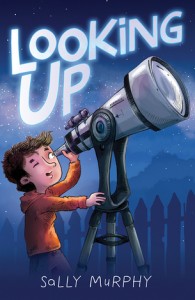
Looking up (Published by Fremantle Press) is a novel about a boy who gets more than he imagined was possible for his tenth birthday. With topics of family and communication, and suitable for studies of narrative, as class read aloud and for private reading. You can read a Sample Chapter Here, Teacher’s Notes are available Here and some suggestions for Year Three teachers HERE.
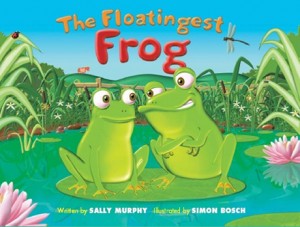
The Floatingest Frog (illustrated by Simon Bosch, published by New Frontier). The story of two frogs who spot a cow and wonder if they can be bigger than it, it is based on an Aesop’s Fable, the Frog and the Ox, and also delas with competitiveness and sibling rivalry.<p>What can it be used for: Because it is retold fable (you can see one version of the original fable here) there is the opportunity to explore fables and also link to science and the topic of frogs. You’ll find a collection of frog related videos used in a unit which followed on from reading The Floatingest Frog here .Although it is a little hard to find in stores, The Floatingest Frog is still held in many school and public libraries and available for sale directly from me, posted anywhere in Australia for $20. It is also perfectly accompanied by my nonficton title:
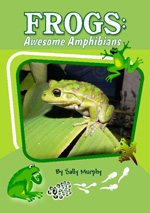
Frogs: Awesome Amphibians (Published by Ready Ed) A handy classroom/library reference, or as private reading, it can be purchased online direct from the publisher. This excellent science unit of work could also be a useful resource.This is just a portion of what I have written suitable for this age group. There are also several reading series titles and novels including Doggy Duo.
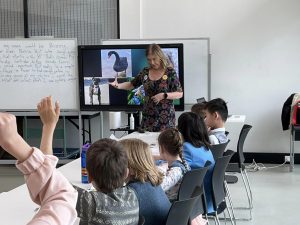
And, if you’d like to see me in person, I am available to visit your school
for author visits or to run professional learning. Feel free to contact me to find out more. You can also do the same if you’d like some advice on using my books in your classroom.
by Sally
Yesterday I shared some book suggestions for Early Childhood classrooms. Today I have some offerings for junior primary – years 1 and 2. If you are a teacher planning for the year ahead, these are books which I’ve written which you may find useful in your classroom, either for reading aloud, private reading for pleasure, or for English and other lessons.
Firstly, I have four picture books suitable for junior primary.
Do Not Forget Australia (illustrated by Sonia Kretschmar and published by Walker Books). Telling a story of friendship between two boys and between two countries, through the events at the French village of Villers-Bretonneux in and after World War 1.
Meet Mary Mackillop (illustrated by Sonia Martinez, published by Random House). Part of the fabulous ‘Meet…’ series from random House, this is a fictionalised story of the life of Mary Mackillop, with a back of book timeline of her life.What it Can Be Used For: Because it features a famous Australian, there are obvious HASS uses, as well as use in Catholic schools, with Mary Mackillop being Australia’s first saint. But this is also the story of a strong woman, and highlights social justice and history, so is suitable for all classrooms. You will find publisher teacher notes here and suggestions for the year 4 classroom, which could be adapted for younger students here. Meet Mary MacKillop appears on the booklist for the South Australian Premier’s Reading Challenge and is still available in good bookstores or online.
The Floatingest Frog (illustrated by Simon Bosch, published by New Frontier). The story of two frogs who spot a cow and wonder if they can be bigger than it, it is based on an Aesop’s Fable, the Frog and the Ox, and also delas with competitiveness and sibling rivalry.What can it be used for: Because it is retold fable (you can see one version of the original fable here) there is the opportunity to explore fables and address ACELY1665 (Discuss different texts on a similar topic, identifying similarities and differences between the texts) and also link to science and the topic of frogs. You’ll find a collection of frog related videos used in a unit which followed on from reading The Floatingest Frog here .Although it is a little hard to find in stores, The Floatingest Frog is still held in many school and public libraries and available for sale directly from me, posted anywhere in Australia for $20
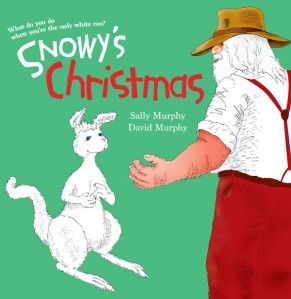
Snowy’s Christmas (illustrated by David Murphy, published by Random House). Although, in January, Christmas seems a very long way away, it will be here before you know it – and, besides, who says you have to wait until Christmas to read a Christmas story? Featuring a white kangaroo, this is an Australian Christmas story, and effectively an Australian version of the famous Rudolph story.What can it be used for: As always, reading for pleasure and, at the end of the year, particularly the pleasure and excitement of Christmas. Addressing literacy outcomes also listed above, but also a wonderful tie-in for Christmas-themed units of work, or units focussing on Australian animals., as well as on self acceptance and families. These teaching ideas, are linked to Year 2 learning outcomes.As with The Floatingest Frog, Snowy’s Christmas is a little hard to find in stores, but is still held in many school and public libraries and available for sale directly from me, posted anywhere in Australia for $18.Secondly, some longer books for junior primary.
Queen Narelle (illustrated by Simon O-Carrigan and published by Walker Books) is a verse novel told from the alternating viewpoints of Maddie and her cat, Narelle. The use of the cat’s voice makes it fun, but the issue Maddie is facing – about friendship challenges – is very real, and very important. What it Can be Used For: Verse novels are excellent as teacher read alouds, and, because of the combination of narrative and poetry can be used to address many parts of the curriculum including, in the case of Queen Narelle, ACELT1562 (Discuss characters and events in a range of literary texts and share personal responses to these texts, making connections with students’ own experiences). The exploration of friendship and bullying, as well as of family, makes it also an excellent text for HPE classes. You’ll find a simple teaching suggestion, pairing Queen Narelle with a stand alone poem, here.Queen Narelle is available in good bookstores or online, as well as in many school and local libraries.
The Sage Cookson series (Published by New Frontier) Each of the eight books in this series stand alone, though as a series they work well read chronologically. Sage Cookson travels the world with her parents, who are TV chefs, but along the way she gets into lots of scrapes.What They Can be Used For: Series fiction is great for independent reading, particularly as it encourages readers to engage with multiple books. However, this series is also suitable for classroom read aloud, and has been used in studies of narrative structure and to teach the recipe text type, with each book featuring a back of book recipe. The series is included on the reading lists for the WA and NSW Premier’s Reading Challenges. Although harder to find in bookstores, this series can still be found in many libraries, or bought direct from the publisher or ordered from me.If you know anything about my writing, there’s a pretty good chance you know that I love poetry, and love to see it taught and enjoyed in the classroom. I have two books suitable for educators, both including poems by myself and others suitable for classroom use.
Teaching Poetry for Pleasure and Purpose ( Published by PETAA) is, as the title suggests, designed to help you in teaching poetry in pleasurable ways, but also with the purpose of supporting the demands of the curriculum. There is a chapter for each primary school year, including Years 1 and 2, unpacking key terminology, suggesting activities both in reading and writing, and including poems and suggestions for further resources. Teaching Poetry for Pleasure and Purpose is available directly from PETAA in both hardcopy and digital formats. PETAA also offer an online professional learning module of the same name, where you can hear more from me on the teaching of poetry.
Assembly (published by Ready Ed Publications) is a collection of printable poems for use for performing, recitation or just having fun with, including poems suitable for junior primary. Each poem is printable, and is supported with a page of teaching notes. Available in hard copy or ebook format directly from the publisher .Last, but by no means least, I am the co-editor of a wonderful poetry anthology.
Right Way Down (edited by Rebecca M. Newman and myself) and published by Fremantle Press) is aimed chiefly at middle and upper primary, but you will find poems in there that will also appeal to junior primary students. You will find teaching notes here and printable poetry activities here. Right Way Down is still available in good stores or online in hard copy or ebook format.
This is just a portion of what I have written suitable for this age group. There are also other picture books, which unfortunately are no longer in print, but may be in your school library (including Fly in Fly Out Dad and Pemberthy Bear) as well as several reading series titles and novels including Doggy Duo and Roses are Blue.
And, if you’d like to see me in person, I am available to visit your school for
author visits or to run professional learning. Feel free to contact me to find out more. You can also do the same if you’d like some advice on using my books in your classroom.
by Sally
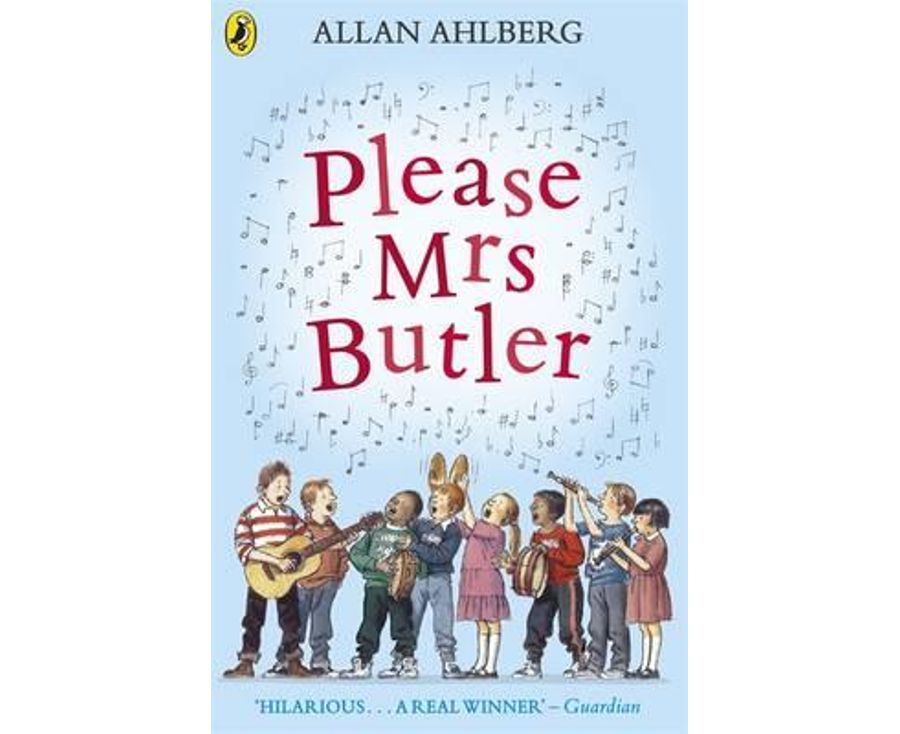
I have been enjoying reading a poetry collection Please Mrs Butler, by Allan Ahlberg
(Penguin, 1983) which is a varied collection of poems about school life. One poem, in particular, stood out to me, as being ideal for reading, and discussing, alongside Queen Narelle.
So, If you are reading Queen Narelle in your classroom, or your home, you might enjoy Small Quarrel, which is available online at the CLP website here, with a video reading by the poet, which I have also embedded below.
You might discuss the similarities and differences between the poem and the events of Queen Narelle. I’d love to hear your thoughts!
by Sally

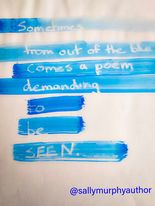
I’ve been sorting through old drafts and folders, and came across this poem, which I wrote some years ago as part of a Facebook challenge (the set topic was ‘blue’).
Not exactly a work of art, but today I took a photo of it and shared it on Instagram – and then was left thinking about how, sometimes, poems, and stories too, really do seem to just appear, and I know I have to write them down and share them. This led me to ponder how ideas really can come from just about anywhere.
Take Queen Narelle as an example. The idea from this book came from a fairly random sequence of events. In 2008 I wrote Pearl Verses the World (and THAT story came to me from a voice in my head that insisted I write her story). A year later, it was published, with gorgeous illustrations by Heather Potter.
When I was busy promoting the book, a boy called Cassidy emailed some questions for me to answer from Pearl’s perspective. These were really perceptive questions – Cassidy was a very cluey nine year old. You can read the interview here.
So, Cassidy asked me/Pearl, ‘what is your cat’s name?’ and I have to admit this stumped me – because I had not given Pearl a cat. There is no mention of a cat in the story I wrote. BUT Cassidy had seen Pearl’s cat – there in several of Heather Potter’s gorgeous illustrations. So, if I was answering as Pearl, I couldn’t say I didn’t know the cat’s name. I thought fast, and gave the cat the name of a cat from my own childhood: Narelle.
The interview was published and I moved on. Except, I kept thinking about that cat. Because there is a humorous reason we called our cat Narelle. Narelle, you see, is the sound a cat makes. It doesn’t say miaow – it says Naarrellllllleee. And, having remembered that fact, I couldn’t stop thinking about a cat called Narelle. Eventually I decided that Narelle deserved a story of her own.
When I sat down to write, however, it wasn’t Pearl’s cat, or even my ‘real’ cat, that seemed to want to have their story told. It was a different cat. And she was determined to tell her story in her own voice. The first draft of Queen Narelle didn’t take long to write – and it was all from Narelle’s first person viewpoint.
Since 2009 that first draft has had many revisions and edits, including adding in a
second narrator – Maddie, Narelle’s favourite human. Doing this made the story richer, more complete, but I have always loved writing in Narelle’s voice. It was lots of fun, even though there are tricky things happening in the book. Those things evolved from me trying to figure out what problems a cat might have, or witness, and how a cat might be involved in their resolution.
So, in this case, the idea came from a simple question about one cat, and a chain of thoughts about that cat, and a very demanding cat demanding to be written about.
Of course, other stories and poems have their origins in other places. I might write about some of my other story origins in coming posts.
by Sally
Purring joyfully at this delightful picture of a delightful young reader, Evie, in her Bookweek costume. No prizes for guessing who she is – my Narelle!

Thanks Evie for celebrating my book-baby in this way – and to her family for sharing the photo with me.