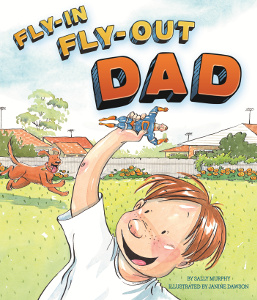
I love my postie. But some deliveries are more special than others. This is what came today:

Fly-In Fly-Out Dad will be released in July but if you can’t wait till then, it’s available to order now from Five Mile Press.
by Sally
I love my postie. But some deliveries are more special than others. This is what came today:

Fly-In Fly-Out Dad will be released in July but if you can’t wait till then, it’s available to order now from Five Mile Press.
by Sally
Want a sneak peak of my next new book? No? Well look away now. Yes? Well you are in luck, because here is the front cover for you to admire:

Fly-In Fly-Out Dad, published by Five Mile Press and illustrated by the amazing Janine Dawson, will be released on July 1, and I can’t wait.
by Sally
While the majority of the action in Australia’s Great War: 1915 takes place at Gallipoli, a really important part of the book is the communication between Stanley and his twin sister, Elizabeth, who is back at home in Bunbury. Stanley writes to Elizabeth and shares his experiences and, importantly, his feelings about them. Elizabeth, in turn, tells Stanley about the things that are happening – big and small – at home, as well as her concerns about Stanley’s wellbeing.
About 420 000 Australian men and women served in World War I. Almost every one of those people had loved ones at home – wives, parents, children, siblings. They came from communities in which they each played their own roles before the war – in employment, in sporting teams, in social life, as volunteers.
So, while the war was raging overseas, in Australia life was different too. Parents worried. Wives fretted. Siblings tried to filled gaps. Employers tried to carry on their business without their workers, and had to train new staff. Communities changed. Perhaps most significantly, children grew up without their fathers. And all of these people, of course, mourned when lives were lost.
When I hit upon the idea of making Stanley, my main character, a young teacher, I knew this could give me an opportunity to show what life was like on the home front, through his classroom. Because of course while Stan was away at the war, his pupils would still be at school. Wondering who his replacement teacher might be, I hit upon the idea of a twin sister, also a teacher, taking over his class.
Then as I started to write I realised that it wouldn’t just be Stanley who Elizabeth and their students would be linked to, because it would be likely that the students themselves would also have family members, friends or neighbours off at the war. So I created the characters of Miles Parker – who fights alongside Stan – and his sons, back home in Elizabeth’s classroom. This was to provide some of the most emotionally difficult material for me to write as I considered the impact of the war on two young boys.
Of course lots of the details about the home front that are part of the book are seemingly small things – dances, engagements, changing seasons – because life at home did go on, but also because when you are far away from home you like to know what’s happening there. Elizabeth keeps Stanley informed about these things as much, or more, than she does about major happenings. But Elizabeth’s role is not incidental or trivial: it is a key part of the story. Without a home to miss, a country to be fighting for, the war would be meaningless to those who were there.
by Sally
It’s Poetry Friday, which is always good news, but this week I have some additional good news to share, because my verse novel Roses are Blue was named a Notable Book by the Children’s Book Council of Australia book of the year judges. Hooray!

To celebrate the notable listing and Poetry Friday, in the one go, I thought I would share a short extract from the book. It is a little moment where my character, Amber, who is having a really hard time, finds solace in doing something she loves.

Have a wonderful Poetry Friday. I know I will. For the rest of the fun, head over to Life on the Deckle Edge where Robyn is hosting the round up.
by Sally
While Australia’s Great War: 1915 is a work of fiction, not all of the characters are made up. Several of them are based on real people who served in the Great War. By populating the story in part with fictionalised versions of these famous people, I hope to keep their memories and their parts in history alive. Of course, with my main characters being made up, the interactions they have with the ‘real’ characters must also be made up, but they are based on things which could have happened.
So, who are these real characters?
Finally it’s time to let you in on a little secret. There are some much less famous real people embedded in the story. My own grandfather, Jim (James ) Adam, who served in the war, on the western front, is mentioned in one of Elizabeth’s letters. My husband’s grandmother, Audrey Chadd is also mentioned, playing the piano for a dance Elizabeth goes to. Though this couldn’t have happened – she was only a year old at the time – the Chadd family (her inlaws) were in business in Bunbury at the time, and Audrey, when she grew up, did play her piano for dances and events around Bunbury for many years. She even played at my wedding! There are a few other little hidden bits in the story that are my own little homage to family history.
Famous or not, it is important to remember that everyone who went away to war was a real person who did their bit, big or small. As such, retelling the stories of those terrible times commemorates them all.
by Sally
Want to read a book for free? Don’t we all! Twice in the past week I was reminded of this by young fans.
First, a young reader emailed me asking if I knew any websites where she could read 1915 for free.
A few days later, another young reader told me she had read Roses are Blue online. This lead me to Google and sure enough I found a site where people could read Roses are Blue for free. The gorgeous young girl who told me about it had no idea that the online version was pirated – and I’m really glad that she told me, and also that this gave me an opportunity to chat with her about why such sites are problematic.
It’s wonderful that kids want to read my books, and I get that often readers can’t afford to buy the books they are interested in reading. But I do wonder if readers, young and not-so-young realise that sites that offer free scans of books (whether in pdf or ebook formats) are illegal, and that this is a form of piracy.
The pirates who share books online think that they are doing the world a favour. After all, authors and publishers are rich, and books are too expensive, so why not just put the books online for free? And the readers who download them, as I’ve said, may not know that it is stealing, and, if they do, they may also feel that it’s okay because authors are rich.
So, here in simple terms is why you shouldn’t read books through pirate sites (or, for that matter, upload books to those sites):
I’m not attacking my two young readers. Neither realised that what they were doing was wrong, and I hope my responses to them educated them but didn’t make them feel ashamed. It’s a shame that this seems to be a growing issue, and one that so many people don’t understand. If you, or someone you know, uses pirate sites to steal books – please reconsider.