I could give hundreds of reasons, but managed to get it down to ten
View this post on Instagram
by Sally
I could give hundreds of reasons, but managed to get it down to ten
by Sally
This is the fourth post in this series – each one focussing on a different level of schooling. the idea is that, if you are a teacher preparing for the 2025 school year, you might find some ideas for using one or more of my books in your English or other lessons. Today I’m focussing upper primary, so if you are teaching Year 5 or Year 6, this post is for you.
Turns out that upper primary is really the sweet spot for a lot of my books, so this post will be longish.
First up, novels, including verse novels.
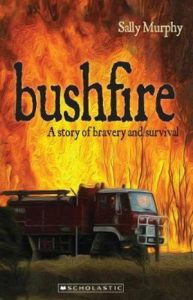
Bushfire (Published by Scholastic). Part of the My Australian Story series, this tells the story of the dreadful 2009 bushfires which ravaged Victoria, from the viewpoint of a fictional girl called Amy, who experiences the fires first hand. It obviously deals with natural disasters, but also focusses on notions of bravery, family and the topic of climate change.How it can be used: Bushfire is useful for studies of narrative, as well as HASS and Science themes. I have heard of several school using it a unit of work on natural disasters, including Clyde Primary in Victoria, who you can read about here. You can find publisher teaching notes here, and a great complementary title The Bushfire Book by Polly Marsden also has excellent teaching notes, which you can find here. Another truly excellent resource is the Black Saturday Museum in Marysville (where much of the book is set) and its website. This song (and its video) by Greg Campion) provides an audio-visual link which can be very powerful.Bushfire is still available from good bookstores and online and appears on the reading lists for the Victorian, NSW and SA Premier’s Reading Challenge.
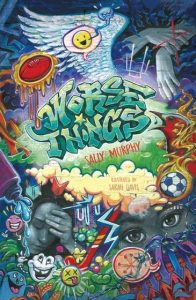
Worse Things (illustrated by Sarah Davis, published by Walker Books) is a multi-voice verse novel about sport, belonging and unexpected things. It was an Honour Book in the 2021 CBCA Book of the Year Awards, which I’m pretty proud of, but I’m even more proud that young readers seem to really engage with it, both for inclass study and individual reading. There are a plethora of resources for teaching Worse Things, including publisher teacher notes here, and a unit of work from PETAA here. The NSW Department of Education has a comprehensive unit of work available here. You might find this video introduction featuring yours truly helpful.
.
Worse Things is still in print and available in print and ebook versions in bookstores or online and appears on five Premier’s Reading Challenge booklists – in WA, Queensland, South Australia, Victoria and NSW.
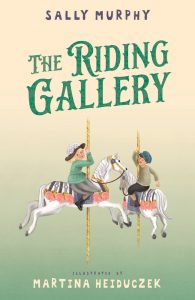
The Riding Gallery (illustrated by Martina Heiduczek, published by Walker Books). My most recent book, this is the story of the homefront during WW1, focussing on the events surrounding a real merry go round (riding gallery) on the St Kilda foreshore. Told using free verse from the viewpoints of two children, the merry go round operator, and the newspapers of the times.What it Can Be Used For: As mentioned, there are HASS and history tie-ins, but, being a verse novel, this one can also be used to teach poetic forms (including found poems), figurative language and more. If you are in the ACT, you might link the story to the merry go round located in the Civic centre – as this is the very ride which features in the book – and, if in Victoria, the book again has strong links to local history, taking place in St Kilda. You can find teacher notes at the Walker site here and PETAA has an excellent unit of work aimed at the year 3 (which could be adapted for upper primary) classroom and linking not just to HASS but also to HPE. You can find that here . The Riding Gallery is available in good bookstores in both print and ebook formats, as well as in libraries and appears on the SA Premiers’ Reading Challenge booklist.
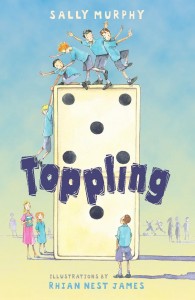
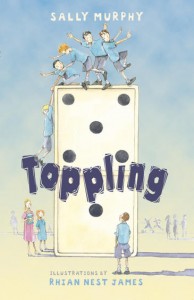
Toppling (illustrated by Rian Nest James, published by Walker Books). A story of friendship, it also delas with childhood cancer, giving it applicability in the HPE classroom as well as a class read aloud. Teacher’s notes for Toppling are available on the Walker Books website and further suggestion, aimed specifically at Year 6, are here.Toppling is still in print and available in good bookstores or online and appears on the booklist for the Premier’s Reading Challenge in WA, NSW, Victoria and SA.
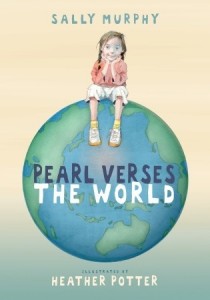
Pearl Verses the World (illustrated by heather Potter, published by Walker Books) is a story of belonging, of family and also of grief. Told using the verse novel format it again has links to HPE as well as making an excellent class read aloud.What it Can Be Used For. Because it uses free verse poetry (as well as some shorter rhyming poems), there is lots of opportunity to address poetic and language devices. among many other uses. The wonderful Kirwan Primary School in Queensland has used Pearl and some of my other verse novels for a year six unit of work for many years,, including studying author’s style, poetry and more. Teacher’s notes for Pearl Verses the World are available on the Walker Books website, and my ideas for using the book in a year five classroom are available here.Speaking of poetry, I love writing and teaching poetry, and these two books are ideal for upper primary:
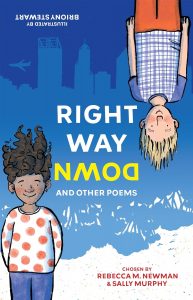
Right Way Down (edited by Rebecca M. Newman and myself and published by Fremantle Press) is aimed chiefly at middle and upper primary students and is suitable both for in class use and private reading, with poems in a wide range of of forms, and on a variety of topics, all written by contemporary poets. You will find teaching notes here and printable poetry activities here. Right Way Down is still available in good stores or online in hard copy or ebook format.
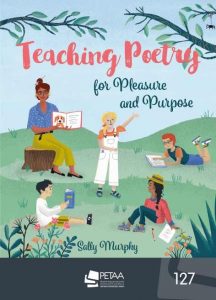
Teaching Poetry for Pleasure and Purpose ( Published by PETAA) is, as the title suggests, designed to help you in teaching poetry in pleasurable ways, but also with the purpose of supporting the demands of the curriculum. There is a chapter for each primary school year, including Years 5 and 6, unpacking key terminology, suggesting activities both in reading and writing, and including poems and suggestions for further resources. Teaching Poetry for Pleasure and Purpose is available directly from PETAA in both hardcopy and digital formats. PETAA also offer an online professional learning module of the same name, where you can hear more from me on the teaching of poetry.This is just a portion of what I have written suitable for this age group. There are also several reading series titles and novels including Looking Up and Doggy Duo as well as my historical picture books Do Not Forget Australia and Meet Mary Mackillop, featured in earlier posts in this series.
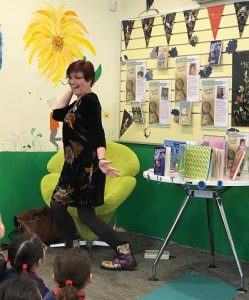
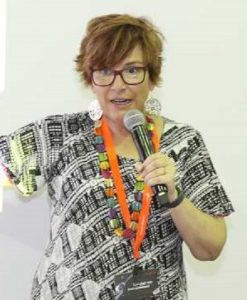
And, if you’d like to see me in person, I am available to visit your school for author visits or to run professional learning. Feel free to contact me to find out more. You can also do the same if you’d like some advice on using my books in your classroom.
by Sally
Exciting news for teachers – and for me! Fremantle Press has produced Teaching Notes
for Right Way Down, now available for free on their website here.
In case you missed my earlier posts about this book, Right Way Down is an anthology of contemporary poetry for primary aged readers, suitable for classroom use and for private reading. It is coedited by Rebecca M. Newman and myself, illustrated by Briony Stewart, published by Fremantle Press in collaboration with Alphabet Soup Books, and including poetry on all kinds of topics and in a range of forms, from some amazing poets.
So, if you are thinking about how to include more poetry in your classroom this year (and why wouldn’t you?) check out the teaching notes now and mark February 27 in your diary for the relapse of the book (of course you can pre-order it now to ensure you get your copy!).
And, if you are looking for a complementary book, and even more poetry and poetry teaching ideas, my PETAA publication Teaching Poetry for Pleasure and Purpose is still available, and includes lesson ideas, resources and poems for every primary year group.
But wait – there’s more! Because if you are looking for someone to visit your school and inspire your students about the fun and magic of reading and writing poetry – I’m your girl. I can also run Professional Learning for you and your colleagues. I love poetry so much I made it the topic of my doctoral studies which kind of sort of makes me a doctor of poetry and means I LOVE to talk about poetry.
by Sally
It’s Teacher Tuesday – though, if you are a regular visitor her you might notice that my Tuesday posts have been a little lax. Apologies: I have been busy with many things, but the good news is that a lot of those things centre around books and writing and poetry.
Speaking of poetry, there is still plenty of time to encourage your students to enter the annual Dorothea Mackellar Poetry Awards, open to school aged students from anywhere in Australia. A writing contest is a brilliant way of motivating young writers to write – and, whether or not they win a prize, their poetry is written by a new audience, and every entrant is recognised with a certificate.
If you are wondering where to start, why not begin my just reading – and sharing – lots of different poetry in your classroom? Here are eight wonderful poetry books that you can access in Australia and that I personally own and thus am able to recommend.
1. , Poems from a Green and Blue Planet, edited by Sabrina Mahfouz (Hodder, 2019). This anthology is stunning. The cover art (by Aaron Cushley) is supplemented with internal spot illustrations, and the range of poetry is outstanding Including original poems, contemporary poems and classics, the theme is celebrating life on Earth. Suitable for primarya nd secondary readers – and adults too.
2.Untangling Spaghetti: Selected Poems, by Steven Herrick (UQp, 2009). Steven Herrick is the best poet for children and teens in Australia so, while I’ve chosen this collection for this book, any of his other collections or his verse novels could equally have been on this list. Humour, pathos, wry observations and more in accessible free verse with a lot to offer middle and upper primary students especially.
3.Guinea Pig Town and Other Animal Poems, by Lorraine Marwood (Walker Books, 2013) . Another eminent and accessible Australian poet, and again there were several titles I could recommend, but I have chosen this one because it is a themed collection, which can provide a lot of food for thought and opportunities to consider the different ways a topic can be explored in poetry. Suitable across the primary grades.
4. Common Wealth, by Gregg Dreise (Scholastic, 2021). This is one of my favourite picture books for classroom use at the moment, but is also a slam poem, and so a wonderful poetry resource – modelling the slam style as a tool for persuasive writing. In your classroom it could be used to cover a range of writing and curriculum areas.
5. What Snail Knows, by Kathryn Apel (ill. by Mandy Foot) (UQP, 2022). This is a verse novel – a story told using free verse, and again, I could have chosne any one of Apel’s verse novels to include in this list. Verse novels offer a wonderful way to explore narrative and poetry at the same time, and this one provides many opportunities to inspire poetry writing, including shape poetry.
6. Roar Squeak Purr: A New Zealand Treasury of Animal Poems, edited by Paula Green & illustrated by Jenny Cooper (Penguin, 2022). I know I have already included an animal themed collection, but this anthology is stunning, and one my favourite books of 2022. Poems about all kinds of animals – from New Zealand and beyond. Eevery library should have htis – and evry classroom and home too.
7 , What is Poetry? by Michael Rosen (Walker Books, 2017). English poet and amazing person Michael Rosen is THE go to for children’s poetry and only falls so far down this list because I wanted to finish the list with two how-to books. This one is about both how to read and how to write poetry, and can be read by children but also by teachers. It is brilliant, but also check out Rosen’s other poetry and his website and his YouTube and…
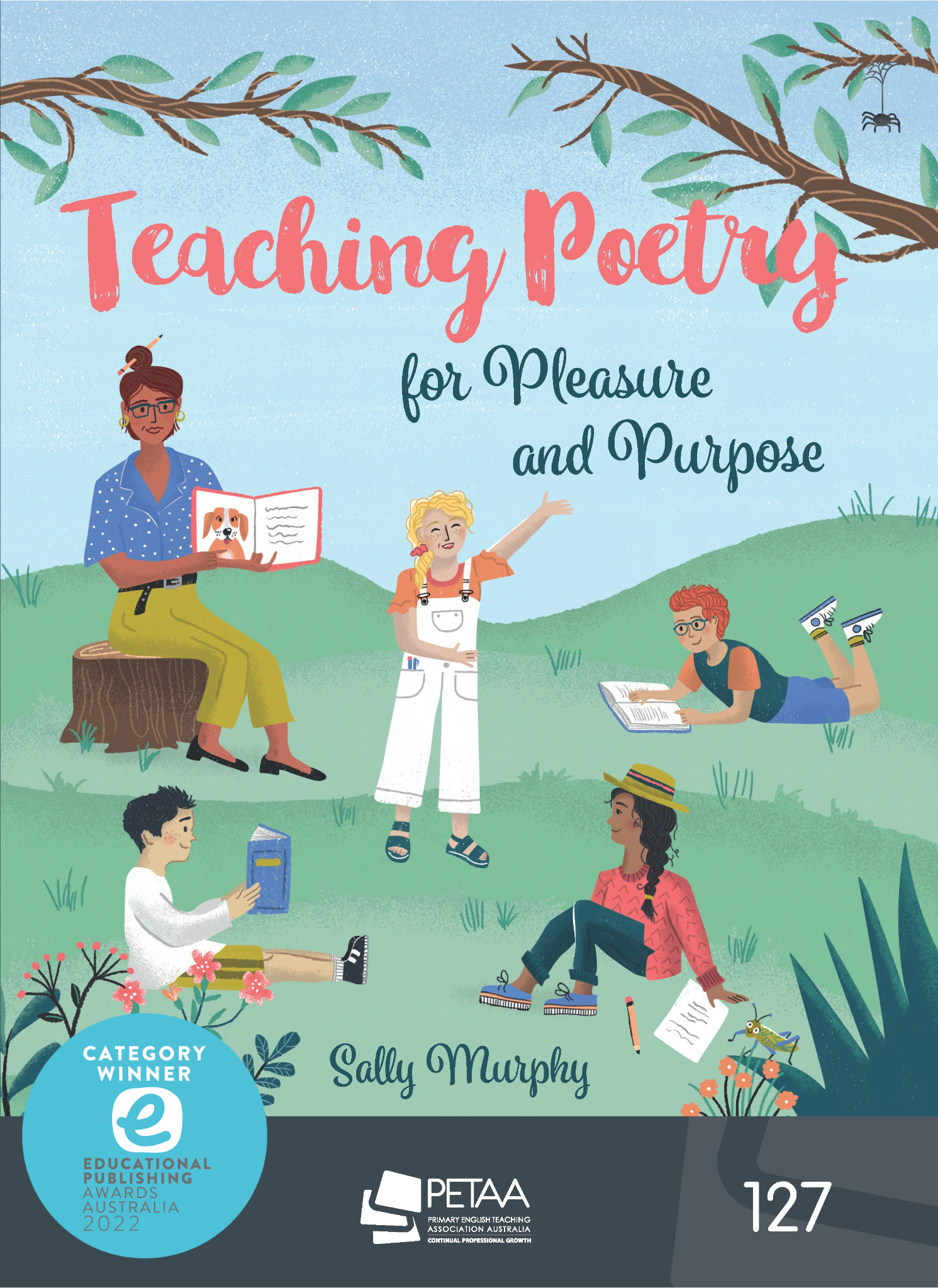
8. Teaching Poetry for Pleasure and Purpose, by Sally Murphy (PETAA, 2021). I am really proud of this book because it is
the book I wished I had when I was classroom teaching. It unpacks the Australian curriculum as it relates to poetry and for every Primary School year level it then gives a range of lesson ideas, both reading and writing, and a selection of poems (mostly Australian) and other resource suggestions. I’d be recommending this one even if I didn’t write it.
I could go on and on listing books here, but sometimes lists can be overwhelming – so here are eight wonderful books for you to get started – but if you need a recommendation for a specific age group or topic, contact me, or comment here, and I will have a suggestion. And if there is a topic you would like me to cover in a future Teacher Tuesday post, hit me up!
And, again, don’t forget that the Dorothea Mackellar Poetry contest is now open for entries. It’s a wonderful opportunity for the young poets in your classroom or your home.
Australia-wide.
by Sally
Hello and welcome to Teacher Tuesday. My goal is to post here every Tuesday with classroom ideas for Australian teachers (and teachers further abroad) but last week I didn’t post because it was one of the busiest weeks of my work year. It was the first week of semester at Curtin university where I work, and I also spent part of the week running writing masterclasses for the Literature Centre in their Talented Young Writers Program.
One of the most delightful things about being a writer is getting to meet and share young readers and writers and ,hopefully ,inspire them on their way to becoming master writers, or just better writers, so I thought this week I would share a version of what I did as part of those sessions last week. I found a really beautiful way to finish each of these extended writing workshops.
During the day we examined the basic tools of a poet: things like simile, metaphor, and onomatopoeia as well as more nuanced tools such as using rhythm and pace even when you’re writing free verse, or layering meaning and connecting with character and place in poetic form. Then at the end of each day I that I wanted to bring all that together and I asked the students to make me cry. What I mean by this is I asked them to write a sad poem.
So what I’m sharing here today is a shortened form of that exercise. Firstly, as I said, we’d covered a lot of poetic techniques before I asked them to do this so if you were doing this in your classroom I would suggest that you would really need to unpack the mentor texts I’m going to suggest or that you already have been working a lot with poetry and therefore are confident that your students will connect either with the mentor texts or with your instructions but I also think this is an exercise that can stand alone.
This exercise is suitable for upper primary right through to secondary and it’s also suitable for adult writers. Firstly, start
with actually sharing some examples of sad poetry. The two examples that I’m recommending are firstly from Pearl Verses the World the scene that goes from page 44 to page 49. If you don’t know the book this is a really intense piece of news that Pearl is receiving and it also is quite sad. When you read that text to your readers you can emphasise the way that there’s not a lot of mention of crying, there is use of repetition and other poetic techniques, but there’s also touches of humour in the lead up to that news being delivered as well as a sense of foreboding that, although it’s humorous, something’s about to happen.
Next, read the second text – from Toppling. Again in this scene John is receiving bad news – you can see there’s a theme here. The pages for this exercise are page 59 to page 63 .
If students haven’t read the rest of the either of these texts I would suggest that you decide exactly where to start and finish, but if they’ve already read the book in class, those are the pages that I recommend. You could do this exercise using other sad poems or sad text extracts you’re more familiar with. I recommend using more than one mentor text to encourage students to look at the differences as well as the similarities.
After you’ve read both passages and you’ve discussed them, the next thing is that you want your students to write. The prompt that I gave to the young these writers was that I wanted them to write me a sad poem and make me cry, and I felt quite confident with doing that because I knew that these students would get what I was talking about having worked directly with me for several hours. I then gave them a choice of two topics:
1. Write a poem about something sad.
2. Write a poem about someone receiving bad news.
I have chosen these because these particular scenes from my two books are both a combination of something quite sad but also in both cases the child in the book is receiving bad news.
Giving young writers a choice that if they actually don’t want to explore something really terrible, the bad news could be a bit flippant. It could be for example someone being told that the Dockers had lost a football game, but I would encourage them to really explore emotion.
One danger in asking children to write a sad poem is that they may just write using lots of ‘sad’ words – crying, tears, sorrow, I feel sad, I was sad and so on. So I really believe in modelling writing either before they write or while they write. As s an educator as well as an author when I ask writers to do an activity I usually also do the same activity on a whiteboard so that they can see my process but also so they have an extra model. I don’t make that example a perfect example, instead I write it on the spot.
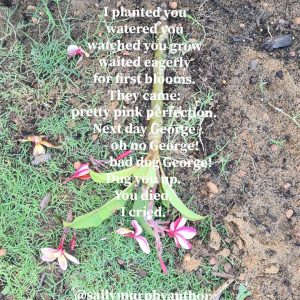
I thought I might share with you these three examples (pictured – click on them to make them larger) which are three different sad poems that I wrote on three different
days For context I did also afterwards share some of the back story on the frangipani poem because I felt that the missing piece of that puzzle was that why I was so sad wasn’t just about the tree – it was also that that tree marked the burial spot of my previous dog. And the Mundy poem is about David Mundy’s last game. I started by thin

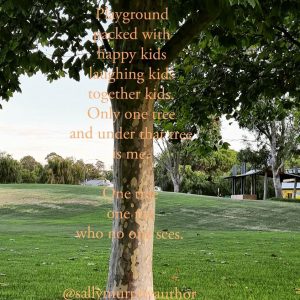
king that I’d write something a bit light hearted by calling it Mundy Mourning with a play on words but actually it ended up bringing me back to what happened at his last game. I surprised myself because I knew I’d feel sad because I’m a Dockers fan. I knew I might cry but when the game finished I cried so much that I almost needed help to leave and that was because it made me think about the fact that my sister who passed away a few years ago loved Mundy as a football player, would have loved to have been there. She would have been cheering and clapping and maybe crying a little bit to see him leave. But she wasn’t there and so when I cried I cried for his last game and then I cried with grief for my sister.

So I’m sharing these poems as examples but I’m happy for you to use one or more of them as mentor texts although I don’t know whether they stand alone without either a tiny bit of backstory or with those other richer texts that
I’ve recommended in Toppling or Pearl Verses the World. They are actually unedited examples of what I wrote on the spot .
SO after the mentor texts and examples simply hand the task over and ask students to write. You can see there is not a lot of structure because I like to trust writers to take the exercise in their own direction, but I also roam and help where needed, especially in a mixed ability group, where more scaffolding might be needed by some students. You know your students, and the amount of support they need, best.
Lastly, if you don’t know about the amazing work of the The Literature Centre in Fremantle, formerly called the Children’s Literature centre or just called the Lit Centre, their Young Writers Programs run from Year 6 all the way through the year 12, some of the most amazing writing offerings for young writers that I’m aware of ,and well worth taking your young writers along to if you have the opportunity.
Thanks for reading, thanks for teaching our next generation, and I would love to hear if this exercise is useful for you. Maybe you could use it to inspire some of your students to enter the Dorothea Mackellar Poetry Contest, which is now open to entries – details here.
See you next Tuesday.
by Sally
It’s Teacher Tuesday and this week I am offering a simple idea for a classroom display that also helps you grow a love of poetry. I call it a poetree.
The idea is very simple: on a whiteboard, or a large sheet of poster paper (the bigger the better) draw an outline of a tree. Here’s an example, drawn for me by a generous audience member at a conference a few years ago:

Once you have the outline, provide sticky notes (you can see I used heart shape ones) or cut out leaves and ask your students to write their favourite lines of poetry to fill the tree up. Or you can have them write small poems, such as haiku or hay(na)ku instead.
If they don’t have favourite lines of poetry, it’s time they did! Add a basket or shelf of poetry books nearby and allow students to choose lines from there.
You can also make your poetree three dimensional using a large pot plant, or branch, or, if there is a tree near your classroom, hanging poems on that – either for a pop up display or, if you laminate them, for longer.
Want more poetry ideas? My book Teaching Poetry for Pleasure and Purpose (PETAA, 2021) contains lots of teaching ideas,
support to find resources and poems by a range of poets including myself. There is even a shape poem called, coincidentally Poetree.
I’ d love to hear if you try this idea, or if you have your own poetry teaching ideas to share. Otherwise, I’ll see you here next Teacher Tuesday.