This spider gave me a fright today, as I tried to hang out the washing. It’s a golden orb. Harmless, but still scared me. Later, though, it inspired a haiku.
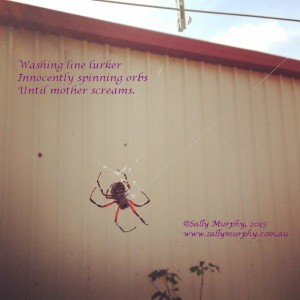
This spider gave me a fright today, as I tried to hang out the washing. It’s a golden orb. Harmless, but still scared me. Later, though, it inspired a haiku.
Among the other wildlife that abounds in my suburb, there are many many ducks. I love seeing them on my walks, and out my front window, though I’m less keen on seeing them when I’m driving. I have to admit it puzzles me that they insist on walking on roads, when they could fly! Fortunately, most drivers slow down and give them to cross.
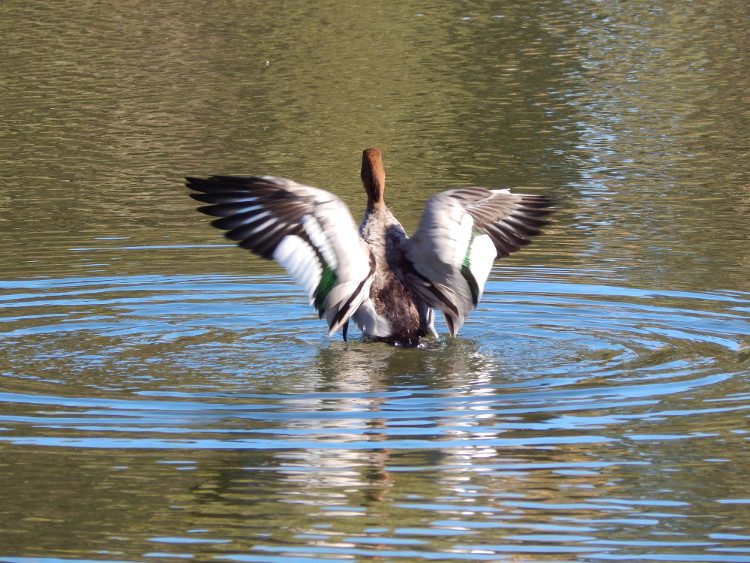
Anyway, because it’s Poetry Friday, and because I’ve been thinking a lot about these ducks, here’s a favourite duck poem, from Ogden Nash, and a favourite duck photo that I took a while ago.
by Ogden Nash
Behold the duck.
It does not cluck.
A cluck it lacks.
It quacks.
It is specially fond
Of a puddle or pond.
When it dines or sups,
It bottoms ups.
What I love about this poem is that, like so much of Nash’s verse, it makes me smile. The humour in the choice of rhyme, and the duck-like flow of the short sharp lines never fails to bring a grin.
Poetry Friday today is hosted at The Logonauts. There you will find links to lots of other poetry goodness.
 It’s been a big week for me – with the release of a new book, the anniversary (bookiversary) of the release of another, and the news that the latter book, Roses are Blue, has also been short-listed in the Speech Pathology Book of the Year Awards.
As a result, when I wondered what I could post for Poetry Friday today I got thinking about poems about books. I think my favourite is from Emily Dickinson:
There is no frigate like a book
To take us lands away,
Nor any coursers like a page
Of prancing poetry.
This traverse may the poorest take
Without oppress of toll;
How frugal is the chariot
That bears a human soul!
The metaphors of a book as a boat, a horse, a chariot taking the reader on great adventures are so apt. I also love that she points out that books offer an affordable and accessible experience, yet at the same time that books are so important that the bear the human soul. Beautiful.
Another favourite is Dylan Thomas‘ Notes on the Art of Poetry:
I could never have dreamt that there were such goings-on
in the world between the covers of books,
such sandstorms and ice blasts of words,,,
such staggering peace, such enormous laughter,
such and so many blinding bright lights,, ,
splashing all over the pages
in a million bits and pieces
all of which were words, words, words,
and each of which were alive forever
in its own delight and glory and oddity and light.
Wow! What magical use of words, words, words to remind us how immense can be the impact of a good book.
Books are my life. Many of my earliest memories are connected with sharing books with my mum, and now I make my living from writing and reading. How lucky am I!
Poetry Friday this week is hosted at Mainley Write. Head over there to see a round up of lots of poetry posts around the blogosphere.
Have a great Friday.
Welcome to Poetry Friday.
During my time in residence last week, I had a request to focus on war poets for one of my sessions. Because Stanley, in my book 1915, writes poetry, the teacher felt I might have some insigh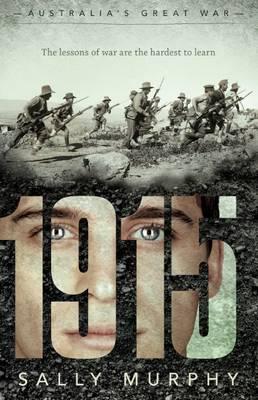 t into the war poets and their work.
This got me thinking about war poetry and the people who wrote (and still write) it.
Often when we use the term War Poets, we are referring specifically to the poets who wrote during and about the first world war. In fact, writing about war has a longer history than that, with poems about experiences of war being written throughout history and still being written today. Still, since world war one was a time where a great body of such poetry was produced and published, and since looking at one era can help shine light on others, focussing on world war one poetry is useful.
The war poets of that time came from a range of backgrounds, and also served a range of roles in the war. Though many were soldiers, others were civilians, or journalists. Many, but not all, were male.
The poems they wrote also varied, from upbeat and inspirational, to poems of loss, of indignation, of despair.
And, of course, the war poems we study and read today are only a portion of what was written, because unless they were published, or kept by family members, many would have been lost in the century that has passed.
So why did these poets write about war? Probably for a range of reasons, but I think that a major reason was as a means of coping. When you are faced with great adversity, great turmoil, confusion, emotion, you need an outlet. Some will vent to their loved ones. Some will pray. Some will write diaries. Some may try to escape through reading. And some will turn to the arts, and create.
The war poets wrote about their own experiences, or the experiences of their friends, their family. Some, particularly in the early days of the war, wrote with patriotism and fervour. Others, especially as the war progressed, and in the years that followed, wrote of their despair.
Some of the poets created before the war, others took it up during and after the war. Some may have written just one or two poems, others wrote volumes.
Who were the war poets? People like you and me, who picked up a pencil and a piece of paper and wrote poetry about their experiences of the time. Why is their poetry still relevant? Because it is a powerful way to connect with the reactions of people of the time to the events of the time.
One of my favourite war poems, is nice and short, and powerful because of this brevity. It is Siegfried Sassoon’s The General:
“Good-morning, good-morning!” the General said
When we met him last week on our way to the line.
Now the soldiers he smiled at are most of ’em dead,
And we’re cursing his staff for incompetent swine.
“He’s a cheery old card,” grunted Harry to Jack
As they slogged up to Arras with rifle and pack.
But he did for them both by his plan of attack.
Not a cheery topic this poetry Friday, but I guess an important one. And, though it’s sad and serious, I think War Poetry works because it makes us feel.
The Poetry Friday round up this week is at Carol’s Corner.
It’s Poetry Friday and I’m glad to be back. Last week I missed posting on Friday – but I had a really good excuse. I was in Singapore, attending the Asian Festival of Children’s Content (AFCC), as well as checking out this amazing city, which I had not visited before.
At the AFCC I participated in two panel sessions, ran an eight hour masterclass (on the subject of book reviewing) and also presented a one hour session on the value of poetry and verse novels. So, because it’s Poetry Friday, I thought I would share a poem which I shared in that session, and talk a little bit about why I shared it.
This is my first published poem for children which appeared in the School Magazine in 2002:
Summer Salad
Cool
Crisp
Crunchy
Carrot
Luscious
Leafy
Lacy
Lettuce
Delicious
Delectable
Delightful
Dressing
Summer Salad
I shared this poem in my session for two reasons: firstly, because it is special to me as my first published children’s poem, and secondly, because I was talking about why we share poems with children.
My feeling is that, even in the educational setting, poetry should be fun. Summer Salad could be used for lessons on healthy eating, or alliteration, or even to begin a writing exercise (crafting a list poem).
But, when children read it, what I hope is that first and foremost they will enjoy the way it plays with words, using vocabulary which is interesting and, perhaps, unfamiliar. Words like ‘luscious’, and ‘delectable’ might be new to child readers, and so the poem invites them to find out what they are, to enjoy playing with these words.
If all we want to do is use poetry to teach stuff, then I may as well have written:
Eating healthy salad
Is very good for you
You should go and find
A lettuce leaf to chew!
Bleh. Writing poetry (and sharing it with children in or out of the classroom) should not be a cynical exercise in force feeding them poetry OR salad.
If we write poetry that invites readers to connect with the topic, with the language, with the emotions expressed, educational benefits are likely to follow. But the pleasure should be foremost!
Have a great Friday. You can see more poetry posts at the roundup, which this week is hosted at Jama’s Alphabet Soup.

It’s Poetry Friday and I am thinking about metapoetry. Did you know that metapoetry is a fancy name for poems about poetry or about trying to write poetry?
Anyway, the reason I am thinking about metapoetry is because my fabulous poet friend Rebecca wrote a fabulous metapoem. At our shared blog, Poetrytag, I gave Rebecca two words and challenged her to put them into a poem (that is how Poetrytag works).
The words I gave her, were: birth and together. Her response blew me away. You can read it here.
The image of a an idea being cocooned and cosseted like a baby is just so fabulous..
Of course, this got me thinking about other metapoems. Another favourite of mine is this Billy Collins poem, which expresses a quiet dismay over the way poems are over-analysed:
Lastly, I remembered a poem about poetry as an opening blossom, and found it after a bit of searching. It is Naoshi Koriyama’s Unfolding Bud which I think echoes what Collins’ is saying – that a poem is something to be treasured, held up to the light, watch unfold, rather than something to be nailed down. You can read “Unfolding Bud” by Naoshi Koriyama on Genius.
Why do poets write about poetry? Because we love poetry – and writing about something you love is pleasurable, enriching.
In the light of the genius above, I almost didn’t share any of my own poetry here, but then I remembered that my character Pearl is also a metapoet. She loves poetry, but isn’t enjoying the poetry unit they are doing at school, because her teacher wants all their poetry to rhyme, so Pearl writes this limerick:
There was a young lady called Pearl
Who was not a rhyming type girl
She said “I’ve no time
For poems that rhyme”
Which made her poor teacher go hurl.
Do you have a favourite poem about poetry?
The Poetry Friday roundup this week will be over at Refections on the Teche. Enjoy!