Christmas is Coming – and my Christmas PB is here!
by Sally
by Sally

I thought it might be useful to take a look inside what happens to put together a children’s magazine, so asked Rebecca to give us the inside story. Over to you, Rebecca.
Thanks Sally. I could go on for pages and pages about how we put an issue together, but I know the importance of word limits, so I’ll restrain myself!
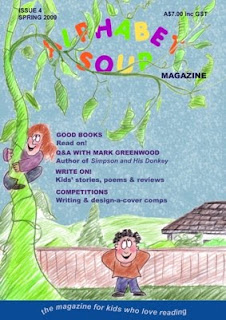
Each issue of Alphabet Soup is 24 pages long, including the cover. And we include the same ‘sections’ in every issue.
A typical issue includes:
Ø a Q&A with an author or illustrator (this issue it’s Mark Greenwood)
Ø a page of book recommendations
Ø a ‘traditional’ tale (e.g. fairytale, folktale, myth)
Ø another adult-written story
Ø a page of poems
Ø a word puzzle page (e.g. crossword or word sleuth)
Ø writing tips for kids (from the Book Chook)
Ø ‘Curiosity corner’—an interest article (e.g. scuba diver, air traffic controller)
Ø 6–7 pages of kids’ writing—book reviews, stories, poems, letters, artwork and the three winning entries of the latest writing competition
Ø info about the latest writing competition, rules for submitting kids’ work etc.
Often the interest article will suggest a theme for an issue, but stories and poems may not always adhere to the theme. We prefer to publish good quality writing—so if we have two items, and one doesn’t follow the theme but is a better piece, we’ll go for that!
The material for an issue is gathered over a number of months. (On 4 September our blog tour makes a stop at Mabel Kaplan’s blog to talk about submissions and how we select work.) I need to finish editing the text before pages are sent to our two illustrators, so that they know exactly how much space they have for artwork. I try to get this done as early as possible for each issue so Greg Mitchell and Annette Flexman aren’t too rushed.
I interview our authors or illustrators by email. Australian authors are a friendly bunch and very generous with their answers. Sometimes their responses are so interesting, it’s hard to know what to leave in and what to cut! But we do have to leave some of it out, as the Q&A is only a double page spread—and there needs to be room for illustrations as well. (Greg Mitchell has had fun drawing caricatures of our authors!) We particularly enjoyed talking to Mark Greenwood for this issue, and we decided to print the uncut version of the interview on our blog: http://www.soupblog.wordpress.com/.
And of course, working on the pages of kids’ writing is always the best part—kids write amazing stories, poems and reviews. We try to fit in as many pieces as we can, without the pages becoming too cluttered, and if we can’t use work, we hold it for a later issue. In the spring ’09 issue, we’ve also included kids’ artwork for the first time.
After all the artwork is scanned in and the magazine is finished, the issue is proofread by our production manager, Katie Lennerts. Her eagle eyes always spot errors we’ve missed! Then we race the disk down to the printer, and start all over again with another issue. Three months rolls around very quickly!

Thanks Rebecca. Sounds like lots of work. You can read more about Rebecca and Alphabet Soup by following her blog tour at the following stops:
1 September Dale Harcombe (Write and Read With Dale) http://www.livejournal.com/users/orangedale
2 September Sally Murphy (Sally Murphy’s Writing for Children Blog) http://sallymurphy.blogspot.com
3 September Claire Saxby (Let’s Have Words) http://www.letshavewords.blogspot.com/
4 September Mabel Kaplan (Tales I Tell) http://belka37.blogspot.com
5 September Dee White (Teachers Writing Helper) www.teacherswritinghelper.wordpress.com
6 September Robyn Opie (Writing Children’s Books) http://www.robynopie.blogspot.com
7 September Sandy Fussell (Stories Are Light) www.sandyfussell.blogspot.com
by Sally
Being an adult is full of responsibility and housework. I wanted to relive the fun days of being a young adult, so I created these characters that I would have liked to hang out with when I was younger. Then I spent the next 18 months with them each day, writing about their misadventures, which was great. Very invigorating. It inspired me to go out and misbehave in real life.
2. Were there any challenges in writing for a younger audience than previously?
The challenges of writing for a younger audience are much the same as writing for an older audience – namely the challenge of sitting still at the computer writing, instead of checking emails, reading the newspaper, doing the sudoku, looking up obscure sites on the internet, drinking coffee and hanging out with friends. Over the years I’ve discovered it’s very difficult to write a novel if you’re not actually sitting down writing it. Rule number one: sit down and write the damn thing.
3. There are lots of issues which arise in the book – fidelity, stalking, drug use, health issues, superstition, family loyalty… Did you set out to write an issues based book and which of the issues do you see as being most important?
When you put it like that there ARE a lot of issues in the book. I didn’t really set out to write something issues-based, and I certainly would never want to get all preachy about things, but I suppose I explored concepts and ideas that I personally find interesting. And also things that have happened to me or friends of mine.
4. Why John Lennon? What inspired you to use a famous person’s name for your main character – and why John Lennon specifically?
Hm. I’ve been asked that a lot and I’m not really sure. His name just kind of came to me. I guess I liked the idea of a character who’s named after a famous person. It seemed to say a lot about his mum, that she would name him John Lennon. It also opened up opportunities for a bit of comedy.
5. Now, about you. What lead you into writing as a career?
I worked in advertising for a long time. But after I had kids and started working part-time, the juicy jobs I’d been getting in advertising started going to other people who were still working full-time. And I found myself writing Myer catalogues and retail television spots and I found it incredibly unsatisfying. So then I applied to RMIT to do the Creative Writing Course where I had this fantastic teacher, Olga Lorenzo, and as I went on, I found that I really wanted to write novels.
6. Do you write full time? What else makes Gabrielle Williams tick?
I’m lucky enough to be able to write full time, which is brilliant (in between sudoku, emails, trawling through the internet, etc). As for what makes me tick; I’ve got a hubby and three children who keep me quite busy, and then I’ve got my buddies who I catch up with a lot, and I do karate, and I sometimes manage to squeeze housework in there somewhere (but let’s be honest, I don’t manage to squeeze in the housework a whole lot. Busy. Doing other stuff).
7. What advice would you give to others who want to write for young adults?
Do it. Do it now. Just don’t write about vampires (seriously, how many vampire novels can the market sustain because it collapses in a toothy, bloody heap?).
8. Lastly, what are you working on now? Is there another novel brewing?
Yes, I’ve got another novel in the pipeline, but I can’t tell you much about it because if I tell you I’ll have to kill you.
You can see my review of Beatle Meets Destiny here.
by Sally
Welcome Claire.
1. What are you doing to promote Sheep Goat and the Creaking Gate?
I’m having two launches, one in Adelaide on 16 August with Judith Rossell who is the very talented illustrator of Sheep, Goat and the Creaking Gate. It will be launched by Julie Wells, President of CBCA (South Australia). The second launch is on 4 October at Collingwood Children’s Farm, Abbotsford in Melbourne. Special guests will be Sally the matriarch goat, and the delightfully named Coffee Table, a sheep and Brigid, one of the Farm’s people, will talk about sheep, goats and the Farm before officially launching Sheep, Goat and the Creaking Gate.
Other promotion will be ongoing, like visiting bookshops, talking to teachers and librarians and visiting schools. I’ve developed a number of activities based around Sheep, Goat. Although it’s a fictional story, I’ve been boning up on the similarities and differences between sheep and goats. I’d not really understood just how similar they were! I do teachers notes which are available on the Windy Hollow website. And of course there is online promotion, like via my website, blog, Facebook and of course blog tours!
2. Why is it important for an author to promote her own books? Isn’t that the publisher’s job?
Sheep, Goat and the Creaking Gate is published by Windy Hollow Books, a small Melbourne-based publisher. There is no publicity department. Windy Hollow send out review copies to a number of reviewers, distribute the book, enter it in CBCA Awards, feature it on their website http://www.windyhollowbooks.com.au/ but they have little other capacity for promotion. Bigger companies may have publicity departments, but they also have more books to promote. I work with Windy Hollow in promotion where the opportunities arise, and otherwise it’s up to me!
3. When planning promotion activities, do you consider how these activities will promote your other books, too? Or do you focus on one at a time?
That’s a really tricky question! When I do an author visit, I take along all my books. I’ll display them all and talk about some of them in more detail. I usually have an activity or a theme for the visit though and that’s generally related to my latest release book. When I’m doing a workshop, I’m aware that I’m promoting me as writer/workshop leader rather than any particular title. I guess that means that I’m hoping that by promoting my name, I’ll be promoting all my books. If I’m at a festival or an event like the CBCA Book Fair, then I’ll take along a selection of books to talk about.
4. What’s been your most successful promotional strategy so far – and why?
I’m not sure I really know how to answer that. If I measure in direct sales, then the launches of my books have been the most successful strategies so far. The launch of Ebi’s Boat was part of the CBCA Book Fair and I was able to include activities beforehand to increase awareness of the launch. ‘A Nest for Kora’ was launched at the Williamstown Literary Festival with the assistance of the Hobsons Bay Library. In both cases, linking with a festival helped with advertising and added to attendances. But if the measure of success is in engaging with audiences, then going into schools is the winner. I love going into schools. Often they’ll say they don’t know my work, but once I start showing them titles, children are always saying ‘Oh, yes, I know that book!’ etc. I can’t measure how much impact that has on sales immediately, but I hope it contributes to recognition of my name and therefore my work.
5. Anything that hasn’t worked for you?
There was a memorable bookstore visit but I’d rather not talk too much about that! The bookshop publicised the event, the posters were there but sigh, it was just the wrong, wrong day.
6. What advice would you give to an unpublished author about promotion?
I don’t know about giving advice. Everyone’s experience is different.
But I guess it’s important to understand that achieving publication is just the first step along the road to success. To me it was as if publication was the top of the hillclimb, until I crested that peak.
Then I discovered that there was another hill to climb, that was promoting the book. I guess another thing to understand is that everyone has their own comfort zone when it comes to promotion. There are many forms of promotion and people will be comfortable with different promotional activities. I was part of a panel discussion at a recent festival, where we discussed promotion. Some people use props, some usecostumes. Others use powerpoint presentations and so on. I guess the point is, everyone is different and has to find their own way to promote.
Thanks a bunch Sally.
And thank YOU Claire. It’s been a pleasure to have you here.
Sheep Goat and the Creaking Gate is available to purchase online from Sheep Goat and the Creaking Gate, and in all good bookstores. If it isn’t in stock, ask them to order it in.
You can follow the rest of Claire’s tour at the following stops:
Monday 17August: Dee White http://tips4youngwriters.wordpress.com/
Tuesday 18 August: Rebecca Newman http://www.soupblog.wordpress.com/
Wednesday 19 August: Mabel Kaplan: http://belka37.blogspot.com/
Thursday 20 August: Sandy Fussell: http://www.sandyfussell.blogspot.com/
Friday 21 August Dale: Harcombe http://orangedale.livejournal.com/
Saturday 22 August: Sally Murphy http://sallymurphy.blogspot.com/
Sunday 23 August: Robyn Opie http://robynopie.blogspot.com/
Monday 24 August: Sally Odgers: http://spinningearls.blogspot.com/
by Sally
by Sally