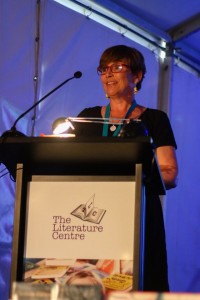
I get invited to speak about my books, and about writing and reading, in the hope that I might inspire or teach my audiences. But every single time that I speak, I get inspired in return, and I am constantly learning things about myself and my books from my audiences. Further to my post a couple of days ago about the links I have started to see between my books, here are a few more things I learnt in Bookweek.
- There are a lot of FIFO families in WA. Actually I already knew that (one article I read suggested
there are 60 thousand FIFO workers in WA), but it was only when I started going into schools to talk about Fly-In Fly-Out Dad that I realised what this translates to. In every classroom there are children with a dad or mum who goes away to work. And in some classrooms, the majority of children are in this situation, or have another close family member (granddad, aunty etc) who does FIFO work.
- Not every FIFO child, even of primary school age, really understands where it is that their absent parent goes, or what they do there. Even eight and nine year olds who knew that their parent was FIFO, didn’t know where it was that Mum or Dad worked.
- Kids love poetry, even though they don’t always realise that what they are reading IS poetry. Lots of kids tell me how much they love my verse novels, but when I tell them that these are poems, they are surprised, especially when the books have been read aloud to them. It doesn’t worry me whether my readers know that they are reading poetry, or whether they know what a verse novel is. What concerns me is whether they are enjoying the stories. The form aids that enjoyment, and the connection with it, but if the reader doesn’t recognise the form, that’s fine. I call his poetry by stealth.

- Using a footy analogy to get my point across never gets old. I have been using the fact that I am a Fremantle Dockers supporter to illustrate why I write books with big highs and low lows for several years. It never fails to get a reaction from the audience, especially in WA where footy rivalry Is strong. One of my proudest Bookweek moments came a couple of years ago when a boy in a Eagles guernsey approached me after my session to tell me he was going to switch to supporting the Dockers.

- Nothing energises me more than a fresh audience. I drove 200 plus kilometres to and from every day of Bookweek this year, and in between sessions and at the end of every day I was exhausted. But when each new audience arrived, I got a lovely whoosh of adrenalin and felt on top of the world. I danced, talked, sang (sorry about that), jumped, paced, talked some more, and loved every moment of it.
Of course, I was pretty weary by the time Bookweek was over, but that’s what weekends are for, right?
All are about absence, and missing loved ones. In
All three feature strong child characters.Tiger is only little, and struggles to understand where Dad goes, and even why they can’t always be together, but he tries to be brave about this. It’s important though, that he is able to recognise that being ‘brave’ doesn’t mean he isn’t allowed to miss his dad or to feel sad about Dad’s absences. In
All three make people cry. I spent a lot of time during Bookweek (as with all my appearances, really) discussing why I choose to write books which rouse emotion. Though I don’t set out to make people cry, I’m kind of glad that I am able to connect with people in this way. And my aim is, that even when someone cries reading one of my books, they should feel happier afterwards.

2. The questions. Some are funny, some are insightful, some are hard, but the questions are one of the best parts of each session.